
 Français
 Deutsch
 Italiano
 Русский
 Español
 Português
 Türkçe
 日本語
日本語 한국어
한국어 Việt Nam
 عربي
عربي


Regarding the number of axes and functions of palletizing robots, the following is a detailed analysis of these two questions:
Item | Specifications | |
Robot model | SZGH-T1600-10C | |
Structure | Integrated | |
Number of axes | 6 | |
Drive system | AC servo system | |
| J1 | ±180° |
J2 | +75~-110° | |
J3 | +110~-75° | |
J4 | ±180° | |
J5 | +30~-200° | |
J6 | ±360° | |
| J1 | 148°s,2.58rad/s 297/s,5.18rad/s) |
J2 | 148°/s,2.58rad/s 297°/s,5.18rad/s | |
J3 | 297°/s,5.18rad/s | |
J4 | 450°/s,7.85rad/s | |
J5 | 225°/s,3.93rad/s | |
J6 | 450/s,7.85rad/s | |
Maximum load | Wrist | 10kg |
Allowable static load torque | J4 | 20.4 Nm |
J5 | 20.4 Nm | |
J6 | 12.7 Nm | |
| J4 | 0.42kgm² |
J5 | 0.42kg ·m² | |
J6 | 0.15kg ·m² | |
Max.reach | 1510 mm | |
Position repeatability | ±0.05 mm | |
Air piping(Option) | φ10×1 | |
Noise level | 70dB(A) | |
Rate power | 4.35KW/5.35KW | |
Rate voltage | Single-phase 220V | |
Installation | Ground-mounted | |
Ambient conditions | Ambient temperature:0~45℃ | |
Environmental performance | IP65 | |
Robot mass | 195 kg | |
I. Number of Axes in Palletizing Robots
Palletizing robots typically employ a four-axis or six-axis structural design. A four-axis robot corresponds to the X, Y, and Z axes in a Cartesian coordinate system, as well as a rotational axis on the Z axis. This design allows the robot to achieve flexible operation and palletizing work in space. A six-axis robot offers even greater flexibility, with a relatively more complex structure, capable of adapting to more complex operational needs.
The number of axes directly affects the robot's flexibility and operating range. More axes mean the robot can perform more complex actions and more precise positioning, thus adapting to more application scenarios. However, as the number of axes increases, the robot's structure also becomes more complex, potentially increasing manufacturing costs and maintenance difficulty.
I. Basic Structure and Working Principle of a Four-Axis Palletizing Robot
A four-axis palletizing robot mainly consists of a robotic arm, a worktable, a control system, and a camera. Its working principle is based on an advanced computer control system, which precisely controls the movement of the robotic arm to achieve the gripping, handling, and palletizing of materials. This robot has four degrees of freedom, enabling it to move flexibly in three-dimensional space and complete complex palletizing tasks.
II. Core Functions of a Four-Axis Palletizing Robot
Improved Production Efficiency: Four-axis palletizing robots can perform palletizing operations continuously and stably, greatly reducing the waiting and rest time for manual operation. Simultaneously, due to its high speed and high repeatability, the robot can complete the palletizing of large quantities of materials in a short time, significantly improving production efficiency.
Reduced Labor Intensity: Traditional palletizing operations require workers to perform a large amount of repetitive labor, which is not only physically demanding but also prone to workplace injuries. The application of four-axis palletizing robots frees workers from heavy physical labor, reducing labor intensity and protecting worker health.
Improved Palletizing Quality: Four-axis palletizing robots use advanced control systems and precise sensors to achieve accurate identification and positioning of material positions. This allows the robot to accurately place materials in designated positions during palletizing, avoiding errors and instabilities that may occur with manual palletizing and improving palletizing quality.
High Adaptability: The four-axis palletizing robot can flexibly adjust to different material types, sizes, and weights to adapt to various palletizing needs. Simultaneously, the robot can automatically switch and combine palletizing operations according to preset programs to meet the needs of personalized and customized production.
Intelligent Management: The four-axis palletizing robot can seamlessly integrate with warehouse management systems, enabling real-time data transmission and sharing. This allows enterprises to monitor material inventory, production progress, and other information in real time, providing strong support for decision-making. Furthermore, the robot can optimize palletizing strategies through data analysis, further improving production efficiency and quality.
III. Applications of Four-Axis Palletizing Robots in Different Fields
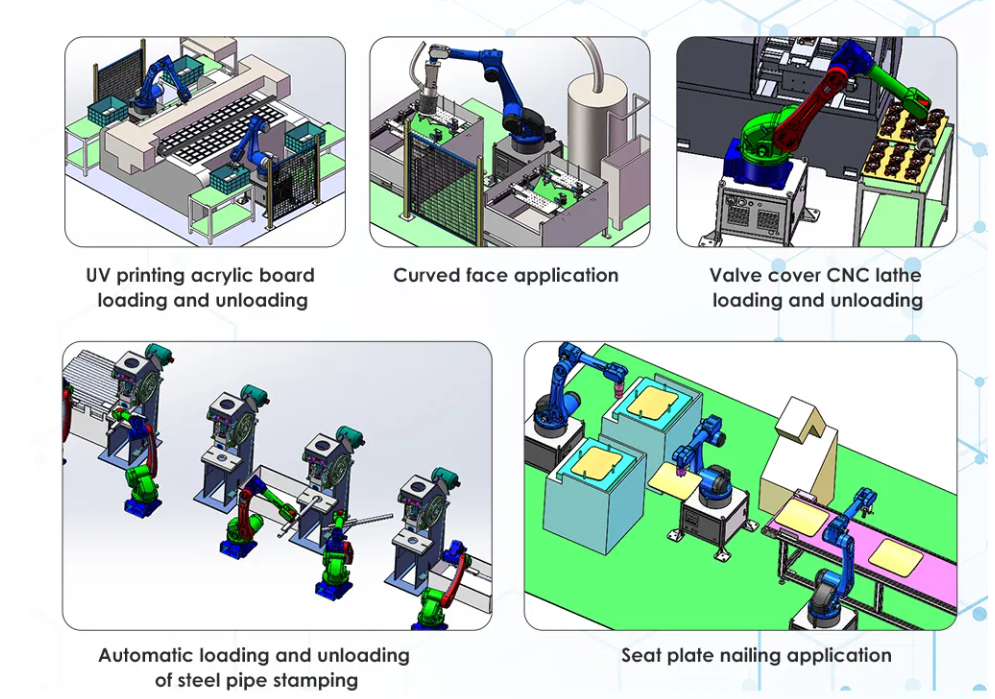
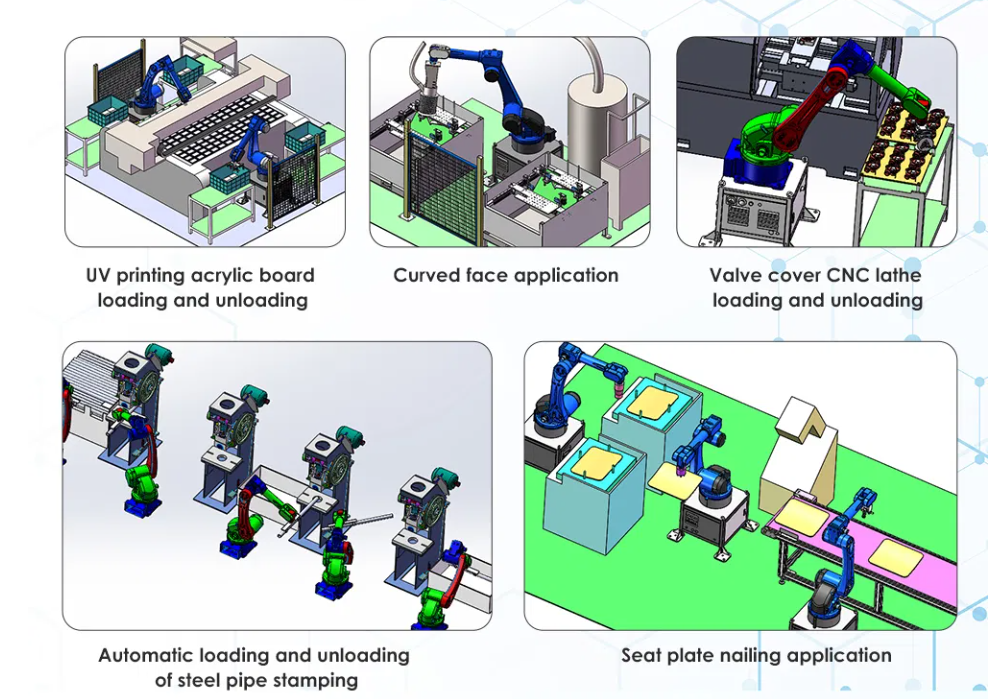
Logistics and Warehousing: The four-axis palletizing robot can replace manual labor in palletizing operations, improving warehouse space utilization and operational efficiency. The robot can stack goods in a specific manner according to preset rules and programs, saving space and reducing human error. In addition, the robot can achieve more intelligent warehouse management and automated transportation through network connectivity and data interaction. In the manufacturing sector: Four-axis palletizing robots can be used to stack and package finished products, improving the automation level of the manufacturing process. The robot can stack and package products according to a pre-programmed sequence, ensuring product quality and consistency. Simultaneously, the robot can flexibly switch between and combine various products for stacking, meeting the needs of personalized and customized production.
IV. Advantages and Challenges of Four-Axis Palletizing Robots
Advantages: Four-axis palletizing robots offer advantages such as high precision, high efficiency, multifunctionality, and flexibility. They can accurately place materials, improving palletizing quality; at the same time, their high speed and high repeatability significantly improve production efficiency. Furthermore, the robot can adapt to different production needs and working scenarios, providing more flexible solutions.
Challenges: Despite the many advantages of four-axis palletizing robots, their application also faces some challenges. First, the initial investment cost of the robot is relatively high, which may be unaffordable for some small businesses. Second, the maintenance and upkeep of the robot requires certain technical skills and experience, necessitating a dedicated team for management and maintenance. Furthermore, with continuous technological development, the robot needs constant updating and upgrading to adapt to new production demands and technological changes.
V. Future Development of Four-Axis Palletizing Robots
With the continuous development of technologies such as artificial intelligence and machine vision, four-axis palletizing robots will achieve more intelligent and autonomous operation. Future robots will be able to more accurately identify materials, adjust palletizing strategies more quickly, and seamlessly collaborate with other intelligent devices to jointly build efficient and intelligent production lines. Simultaneously, with the increasing popularity of robot technology and the continuous reduction in costs, four-axis palletizing robots will be applied in more fields, providing strong support for enterprise production and development.
Summary: Four-axis palletizing robots play an important role in improving production efficiency, reducing labor intensity, and improving palletizing quality. With continuous technological advancements and the expansion of application areas, robots will play an even more important role in the future, making a greater contribution to the sustainable development of enterprises. However, the application of robots also requires full consideration of investment costs, maintenance, and technological updates to ensure that robots can bring long-term benefits and value to enterprises.