


A robotic welding cell maintenance plan should define the cell boundary, isolate hazardous energy before manual access, inspect robot, welding, safety and fume-control items, control consumables, assign trained owners, record findings and verify safeguards before restart; exact intervals and settings should come from the relevant OEM manuals, site risk assessment and local requirements.
Define the scope of the robotic welding cell maintenance plan
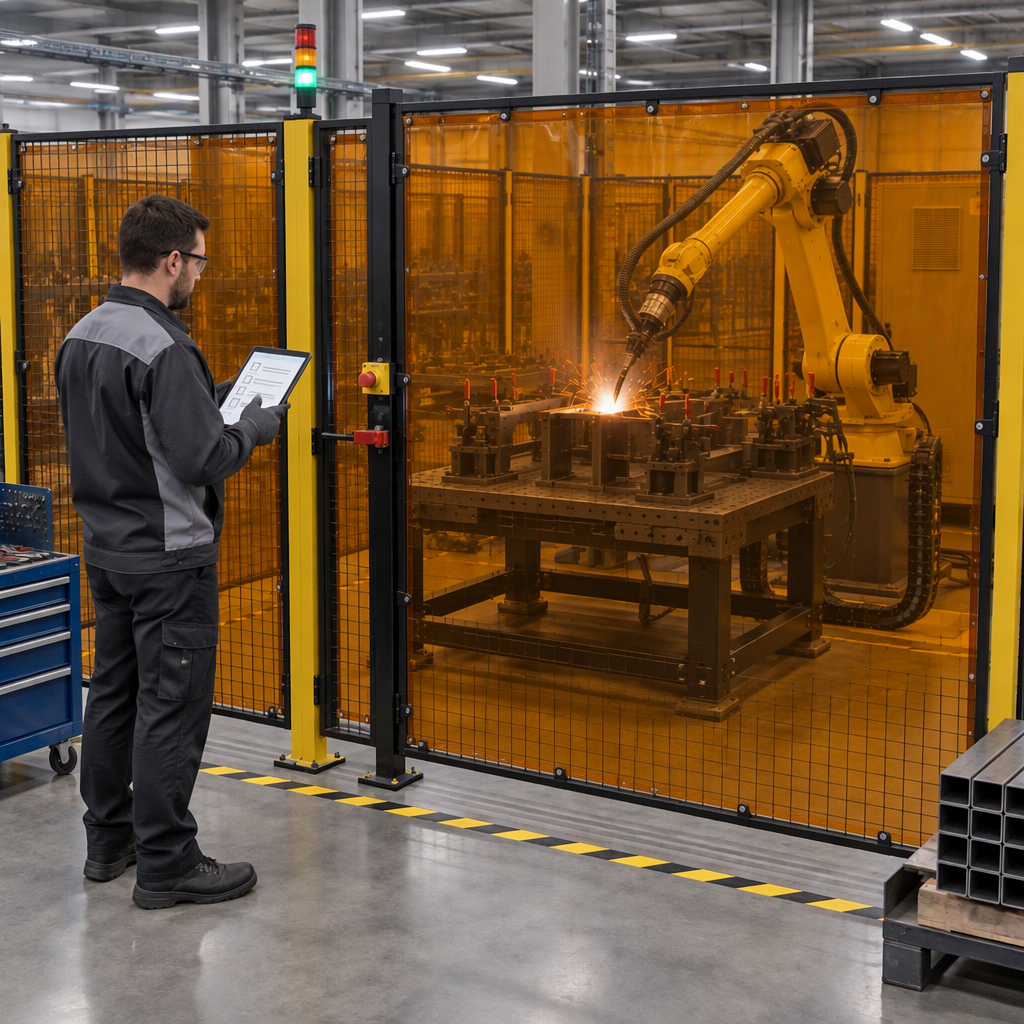
The plan should cover the complete welding cell, not only the robot arm, because welding safety resources address protection, ventilation, fire prevention and confined-space considerations as part of safe welding work.
- Cell layout: robot, controller, teach pendant, welding power source, wire feeder, torch, cables, fixture, positioner, guarding and access points.
- Safety files: risk assessment, safeguarding method, authorized access rules, training records and robot safety documents.
- Process documents: qualified welding procedure, program backup location, parameter ownership and change-approval path.
- Integration records: controller, PLC, HMI or fieldbus interface map, robot I/O list, drive or servo alarm history, feedback-signal checks and restart-approval owner.
- Exposure controls: fume extraction, ventilation condition, PPE availability and any confined-space or restricted-area controls that affect welding exposure.
- Downtime records: fault codes, stoppage reason, corrective action, spare parts used and restart verification.
Build safety and cell-entry controls into the maintenance workflow
Before anyone reaches into the cell, opens guarded space, clears a torch, changes a component or performs manual inspection near powered equipment, the plan should require switching off and disconnecting the applicable electrical, pneumatic, hydraulic and stored-energy sources according to the site energy-control procedure.
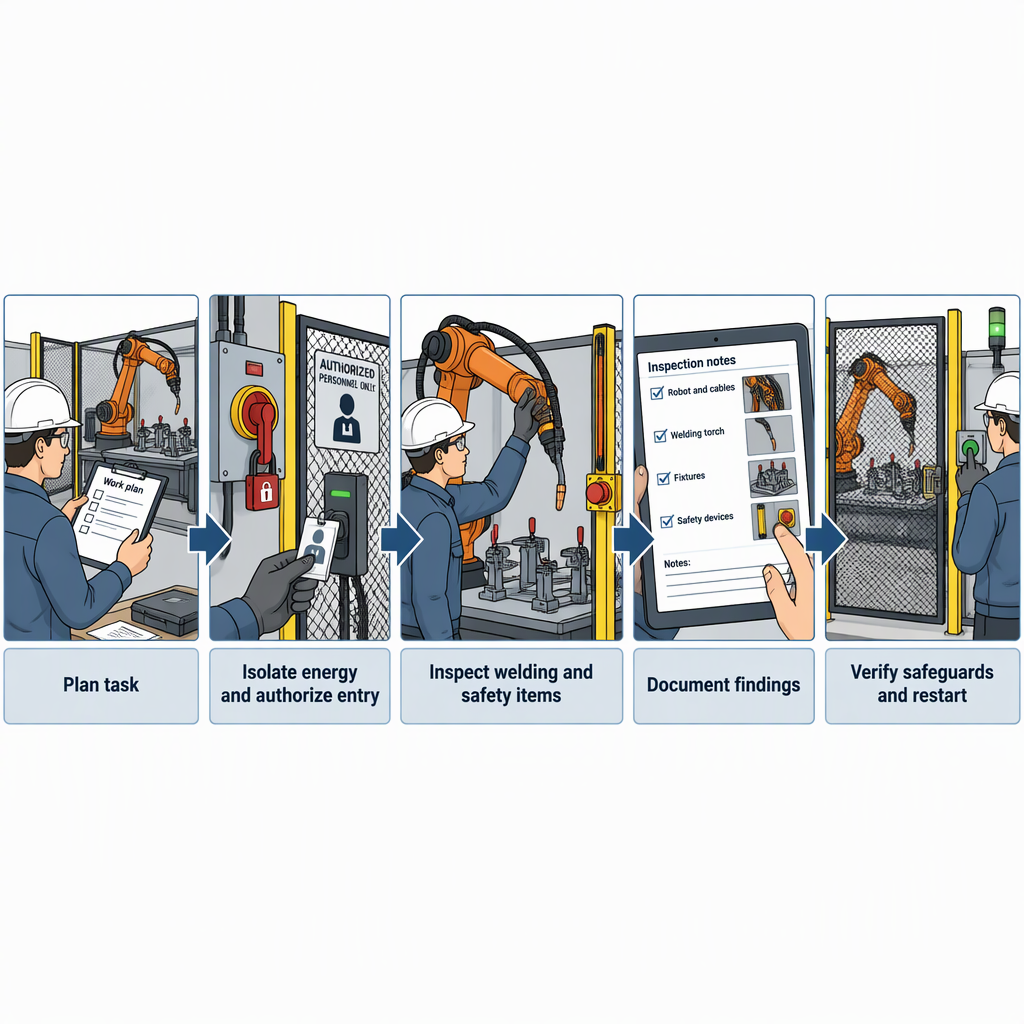
- Define the task and the exact cell zone affected.
- Apply the hazardous-energy control procedure, including isolation, lockout or tagout, training expectations and periodic inspection where applicable.
- Confirm authorized entry and safeguarding requirements against the robot cell risk assessment and robot safety resources.
- Perform only the manual access, inspection or replacement allowed by the equipment manual and the site procedure.
- Remove tools and personnel, restore guards and interlocks, then verify the cell before production restart.
For global projects, U.S. lockout/tagout language is a useful reference point for hazardous-energy control concepts, but the adopted local regulations and the end user’s written safety procedure should govern the final wording.
Do
Write a maintenance workflow that starts with task authorization, energy isolation, guard status and entry control.
Avoid
Do not treat the robot teach mode, a stop button or a manual reference alone as an energy-isolation instruction.
Add welding-specific hazard checks, not just robot checks
Robot welding maintenance should include welding fire prevention, eye protection, ventilation and hazard-communication checks, because welding, cutting and brazing safety requirements address more than robot motion.
- Check for combustible materials, hot-work authorization needs and fire-watch conditions before and after work on the welding area.
- Confirm eye and face protection, warning signs and screens are in usable condition for the task.
- Review fume-control condition because welding fume exposure can vary with wire, rods, flux, base metal and confined-space conditions.
- Inspect torch condition, nozzle cleanliness, contact-tip fit, cable routing, wire feed path and shielding-gas connections according to the supplier manuals.
- Record any change that may affect arc stability, weld location or requalification requirements before returning the cell to production.
The American Welding Society welding safety resources describe AWS/ANSI Z49.1:2021 as covering personnel protection, ventilation, fire prevention and confined spaces. NIOSH also explains that welding fumes contain metals and that exposure varies with consumables, base metal and confined-space conditions.
Set intervals and records from manuals, not assumptions
Do not copy a generic weekly or monthly schedule into a robotic welding cell; build the schedule from each equipment manual, process criticality, duty cycle, operating environment and the end user’s safety file.
| Plan item | Where the exact rule should come from | Record to keep |
|---|---|---|
| Robot, controller and interface inspection | Robot OEM manual, controller or PLC documentation, interface map and site risk assessment | Faults, alarms, cables, backups, I/O or fieldbus status, servo or drive feedback alarms, reference checks and corrective action |
| Welding power source and wire feed path | Power-source, feeder and torch documentation | Consumables changed, settings restored and abnormal wear |
| Guards, interlocks and access devices | Safety design file and applicable local requirements | Test result, bypass prevention, repairs and approval to restart |
| Ventilation and extraction | Industrial hygiene plan and ventilation supplier instructions | Inspection result, cleaning action and exposure-control concern |
If a manual gives a required interval or limit, use that value. If it does not, define an engineering review trigger such as repeated faults, abnormal spatter buildup, consumable variation, cable damage, fixture wear, lost reference position, inconsistent feedback signal or recurring controller-interface alarm.
Plan consumables and spare parts around stoppage risk
Consumables and spares should be planned by failure impact, replacement access and supplier lead risk, rather than by a universal quantity that may not match the cell.
- Classify contact tips, nozzles, liners, diffusers, wire guides, anti-spatter items, shielding-gas fittings and torch service parts.
- Separate planned-change consumables from breakdown spares such as cables, sensors, fixture clamps and safety-device components.
- Define who may change each item, how the cell is isolated first, and how settings are restored after replacement.
- Keep lot, part number and change reason in the maintenance record so recurring defects can be investigated.
- For retrofit projects, confirm physical access, cable routing and replacement clearance before approving the final cell layout.
Assign maintenance roles and documentation ownership
A useful plan names the people responsible for robot, welding, safety and process records, and it should match task complexity to documented competence rather than assuming one technician owns everything.
Good ownership model
Authorized workers receive task-specific procedures and training for hazardous-energy control, and records show who performed the inspection or service.
Weak ownership model
Maintenance notes are scattered across robot alarms, paper shift logs and welding adjustments with no single restart approval path.
- Consider role definitions for robotic arc welding personnel, because AWS lists D16.4M/D16.4:2025 as addressing Associate Technician, Technician and Engineer classifications.
- Give robot program changes, weld parameter changes and safety-device changes separate authorization paths.
- Keep backups of robot programs, welding schedules, controller parameters, interface maps, drive parameters and safety logic in controlled locations.
- Require escalation when maintenance findings affect weld quality, safeguarding, compliance documents or fixture accuracy.
Connect maintenance records to downtime decisions without overclaiming results
Maintenance records can support faster diagnosis and better planning, but they should not promise a quantified downtime reduction unless the site has its own measured baseline and results.
| Downtime signal | Maintenance-plan response | Decision it supports |
|---|---|---|
| Repeated torch collision or touch-sense error | Inspect fixture location, torch alignment, cable drag and program change history | Repair, retrain path or review fixture design |
| Frequent burnback or wire feed alarm | Check consumable condition, liner, feed rolls, wire quality and grounding path | Change service interval or supplier control |
| Guard or interlock fault | Inspect access device condition and restart procedure | Stop production until safeguarding is restored |
| Robot interface, servo or drive feedback alarm | Review the OEM alarm history, controller diagnostics, I/O or fieldbus status, reference position and recent program or parameter changes | Debug the interface, restore documented settings or hold restart approval until the responsible engineer signs off |
| Fume-control concern | Inspect extraction, airflow path and process changes | Escalate to the site safety or industrial hygiene owner |
Use downtime data to prioritize investigation, not to bypass isolation, guarding or welding safety checks.
Verify the cell before returning it to production
Return-to-production should verify that maintenance is complete, safeguards are restored, robot and welding settings are controlled, and only authorized personnel are inside the cell boundary.
- Confirm tools, locks, tags and temporary controls are removed only by the authorized process after the work area is clear.
- Check that guards, gates, interlocks, emergency stops and light curtains are in the required operating state.
- Restore robot programs, user frames, tool data, welding schedules and fixture references from controlled records.
- Confirm welding-area controls such as fire prevention, ventilation and protection are ready for the next production run.
- Run the approved verification sequence, record the result and release the cell only through the defined approval route.
- No unauthorized bypass remains in the cell.
- No loose cable, tool or removed component remains in the robot envelope.
- Any process change has been reviewed by the responsible welding or application engineer.
Conclusion: keep the plan specific, documented and reviewable
The strongest robotic welding cell maintenance plan is specific to the cell, starts with hazardous-energy control, includes welding-process hazards and ends with documented restart verification.
- Use OEM manuals for exact intervals, limits and permitted access.
- Include welding safety categories such as protection, ventilation and fire prevention.
- Keep robot safety, risk assessment and training responsibilities visible in the plan.
- Track consumables, alarms and stoppages in a format engineers can use for decisions.
FAQs about robotic welding maintenance plans
These questions help integrators and retrofit teams turn the maintenance plan into a controlled site procedure.
Is this article a legal compliance checklist for every country?
No. The U.S. hazardous-energy and welding references cited here help frame maintenance topics, but each site should confirm the adopted regulations, local amendments and end-user safety procedures before approving work.
How often should robot welding maintenance be performed?
Use the robot, welding power source, torch, feeder, fixture and safety-device manuals first. Then adjust review triggers based on actual alarms, wear, spatter, consumable changes and process criticality.
Should operators clean a torch or clear wire jams without isolating power?
No. Before manual access, switch off and disconnect the applicable power and stored-energy sources, then follow only the access method allowed by the model manual and site procedure.
What records matter most for robot welding maintenance?
Keep task date, owner, cell status, fault code, component changed, consumable lot, program or parameter change, safety verification and restart approval.
Who should approve changes after maintenance?
Robot path changes, welding parameter changes and safety-device changes should have separate owners, with escalation to the application engineer, welding engineer or safety owner when the change affects their area.
Can a maintenance plan guarantee less downtime?
No. It can make causes easier to see and decisions easier to document, but quantified downtime results require site-specific baseline data and measured outcomes.
Where do ventilation and fume checks fit?
They belong in the welding-hazard portion of the plan because fume exposure varies with consumables, base metal and work conditions, not only with robot motion.


