


Specify robot machine tending by defining the part, CNC interface, workholding, safety boundary, and measured cycle-time events before selecting the robot. A useful RFQ should let the integrator verify the whole workcell, not just compare robot payload or reach.
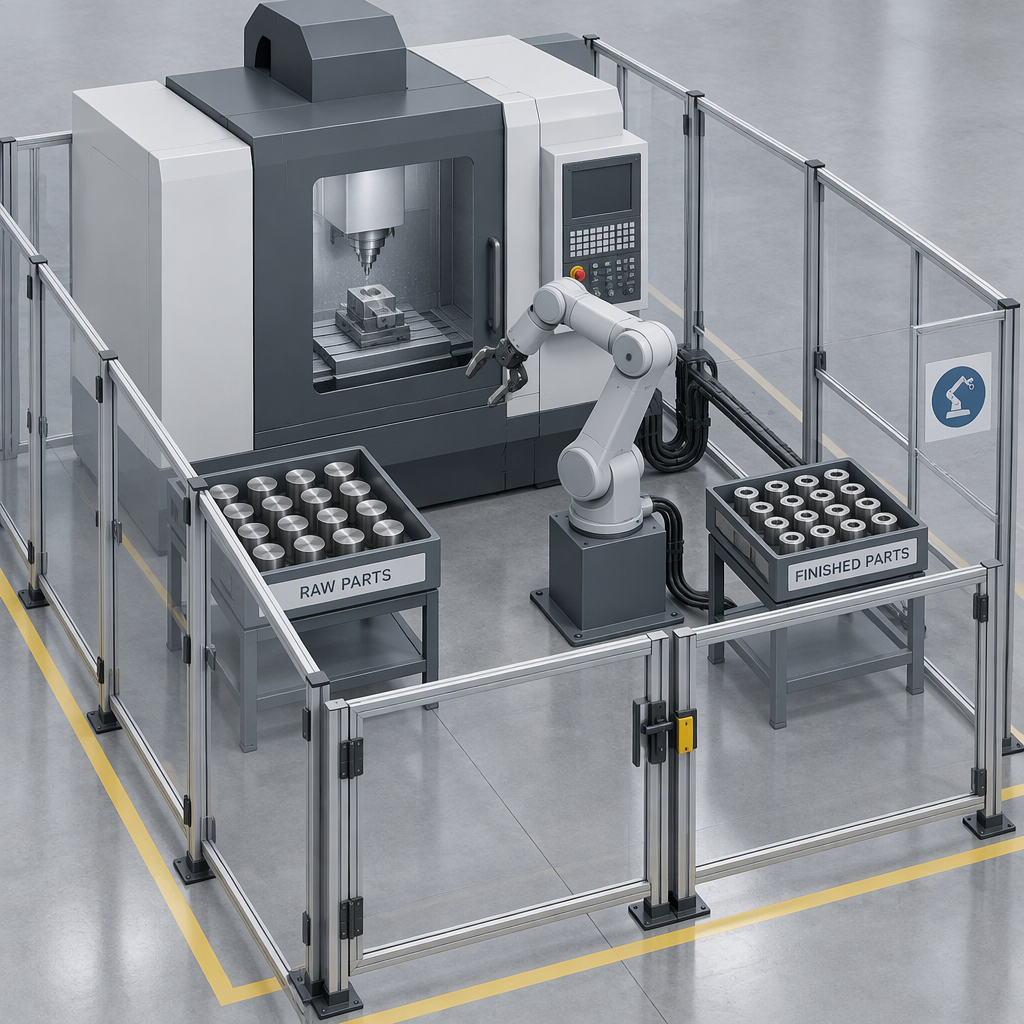
Define the robot machine tending scope before choosing hardware
Robot machine tending is a workcell specification problem: the robot, CNC machine, part presentation, gripper, workholding, guarding, and verification method must be treated as one integrated system.
The NIST robotics program describes manufacturing robotic performance in terms of requirements and verification, which is a useful way to frame a machine tending project before hardware is chosen.
For CNC tending, integration and interoperability can be as important as arm specifications. The project scope should state how raw parts arrive, how finished parts leave, how the CNC door and chuck are controlled, how part presence is confirmed, and how faults are recovered.
This prevents a common early mistake: selecting a robot from payload and reach alone while leaving the interface, fixture, confirmation sensors, and changeover method undefined.
Break down cycle time into robot, machine, and handling events
Cycle time should be decomposed into measured or estimated events so the buyer can see which seconds belong to CNC cutting, robot motion, part handling, confirmation, and recovery allowance.
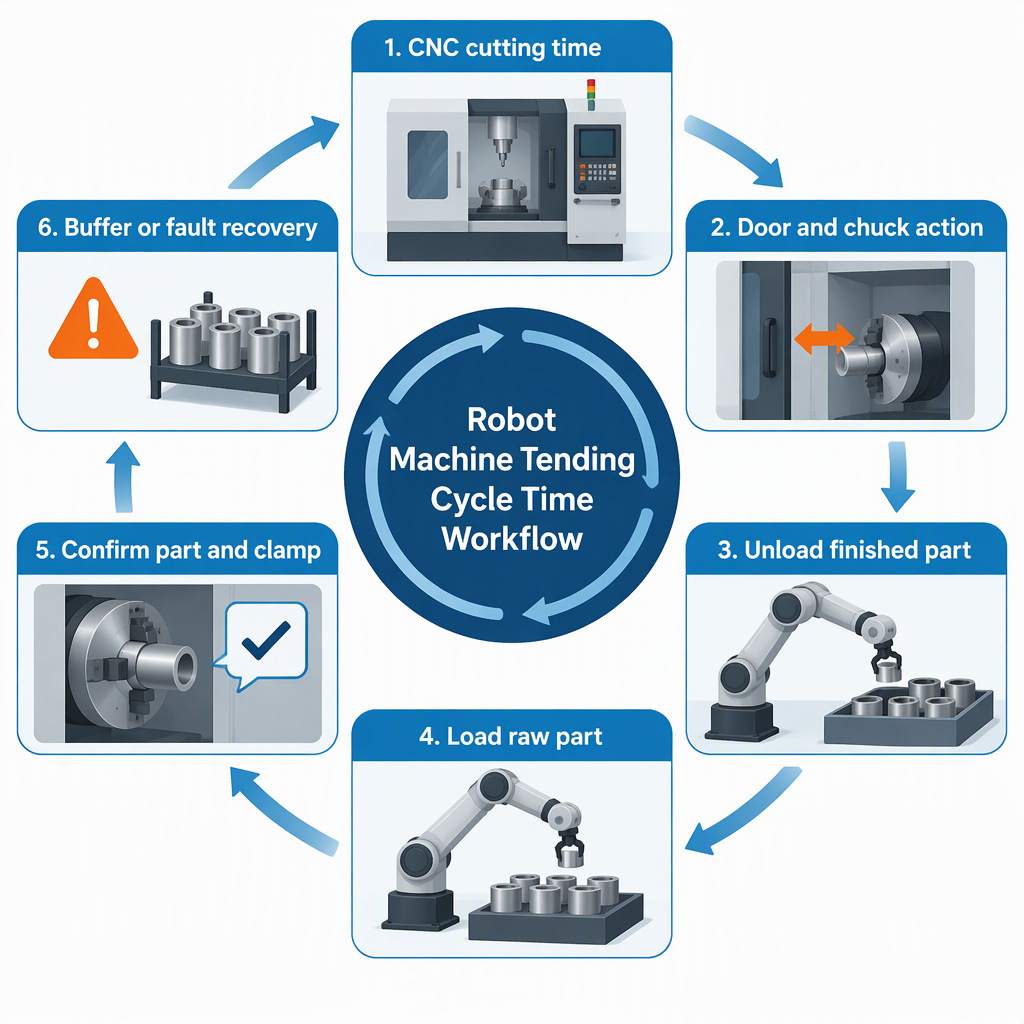
- Record the CNC program time separately from the tending time, because the robot cannot shorten a cutting cycle that is already fixed by the machining process.
- List machine-side events: door open and close, chuck or vise release, air blow-off if used, clamp confirmation, and cycle-start permission.
- List robot-side events: approach, unload, move to finished-part location, pick the next raw part, load, retreat, and wait for confirmation.
- Add presentation and recovery allowances for tray indexing, stack variation, regrip, inspection touchpoints, rejected picks, and operator intervention.
- Define the acceptance method: timed dry run, trial with sample parts, or production-like validation using the buyer’s target mix and changeover assumptions.
Do not turn this breakdown into a guaranteed saving until the part, CNC program, interface timing, and recovery logic are tested together. Treat early timing as an assumption to validate, not as a performance promise.
Collect part and presentation data before designing the gripper
The part data package should describe what the robot must grip, how the part is oriented, and how much variation the cell must tolerate.
A robot tending proposal becomes more reliable when the supplier can evaluate the part and workcell together rather than guessing from a photo or a nominal drawing.
- Part weight, dimensions, center of gravity, and any sharp, oily, hot, fragile, or cosmetic surfaces.
- Preferred gripping area, prohibited gripping area, machining datum, and whether the part needs a reorientation or flip.
- Raw-part presentation method, such as tray, conveyor, bowl, stack, pallet, or manually loaded nest.
- Finished-part placement method, including separation of good parts, suspect parts, and first-off inspection samples.
- Batch size, part family range, changeover frequency, and whether the same gripper must handle multiple variants.
- Tolerance-sensitive features, burrs, chips, coolant, or surface conditions that may affect picking, seating, or confirmation.
Check the machine interface and integration path
Before quotation, confirm how the robot will exchange signals with the CNC, because integration and interoperability limits can decide whether the project is straightforward or custom.
| Interface item | Buyer should confirm | Why it matters |
|---|---|---|
| PLC and I/O access | Available inputs, outputs, M-codes, interlocks, and spare terminals | Defines how door, chuck, ready, alarm, and cycle-start signals can be exchanged. |
| Interoperability path | Whether the CNC, robot controller, safety devices, and sensors can share required states | Reduces commissioning risk when the cell must coordinate multiple devices. |
| Motion or position-control concepts | Whether the retrofit or controller environment supports the intended automation logic | Helps distinguish a simple signal exchange from a deeper controller retrofit. |
| Fault and reset behavior | How the cell responds to missed picks, door faults, low air pressure, or CNC alarms | Determines whether unattended operation is realistic for the target part family. |
| Drive and servo feedback | Whether servo-ready, alarm, position, torque, load, or other drive-status feedback must be shared with the CNC or robot controller | Clarifies what the tending logic can monitor during commissioning and how faults should be diagnosed or recovered. |
NIST’s Robotic Systems for Smart Manufacturing Program identifies integration and interoperability infrastructure as a barrier in manufacturing robotics, which is why the interface path belongs in the first RFQ package.
Use a fit table to screen the application before RFQ
A fit table helps separate applications that are ready for robot tending from applications that need fixture, interface, or process changes first.
| Screening factor | Good fit | Conditional fit | Poor early fit |
|---|---|---|---|
| Part repeatability | Stable geometry and predictable orientation | Some variation that can be managed by nests, sensors, or gripper changes | Uncontrolled shape, position, or surface condition |
| Machine access | Clear robot path and controllable door or fixture | Access possible after guarding, door, or workholding changes | No safe or practical loading path |
| Interface clarity | Signals and interlocks are documented | Signals exist but require retrofit engineering | Unknown interface with no controller support path |
| Cycle-time target | Target is based on measured events | Target is estimated but can be tested with samples | Target assumes unverified savings or ignores recovery time |
This screening does not select the robot model by itself. It tells the buyer whether the application is mature enough to quote and what risks should be tested before the final layout is frozen.
State safety, guarding, and commissioning boundaries early
The RFQ should require a project-specific risk assessment, guarding concept, safe access method, and commissioning plan for the destination site.
Before any manual access to the CNC enclosure, chuck, fixture, gripper, robot end-of-arm tooling, conveyor, or part-presenting device, switch off and disconnect or lock out the relevant electrical, pneumatic, hydraulic, and stored-energy sources according to the site procedure and the equipment manuals. Manual access should be limited to trained personnel using the permitted access method for that machine.
State the required safety documents, local compliance review, guarding responsibility, emergency-stop scope, teach-mode expectations, maintenance access, and acceptance test method before the supplier finalizes the quotation.
Because safety requirements depend on the country, machine, cell layout, and adopted standards, the buyer should confirm applicable rules with the destination-site safety team and local authority rather than relying on a generic checklist.
Separate general selection logic from supplier-specific scope
Use supplier information to confirm relevant product categories and integration scope, but keep performance, certification, delivery, and customer-result claims tied to project-specific documents.
SZGH presents itself as Shenzhen Guanhong Technology Co., Ltd. and describes a product scope that includes CNC machines, industrial robot arms, CNC controllers, servo drives, servo motors, robot controllers, and CNC plus robot integrated automation solutions.
Use SZGH’s GH-1000MC-4 controller page only as controller-category context for concepts such as PLC programming, configurable I/O, position-control modes, and retrofit or custom automation use cases; the specific GH-1000MC-4 product is stated as no longer available, so it should not be used as proof of current availability or project-specific compatibility.
For a robot machine tending RFQ, treat those category statements as a starting point for discussion. Ask for the current controller, robot, servo, safety, and integration documents that match the actual CNC model and destination site.
Prepare the RFQ data package
A strong RFQ package gives the integrator enough data to evaluate feasibility, cycle time, interface work, safety scope, and acceptance testing without assuming missing details.
- Part drawings, sample parts if available, material, weight, surface condition, gripping restrictions, and finished-part quality requirements.
- Target cycle-time breakdown, including CNC program time, machine-door and clamping events, robot exchange time, inspection steps, and recovery allowance.
- CNC make, model, controller, I/O list, available interlocks, M-code or macro options, drive or servo feedback points needed by the tending logic, and any retrofit constraints.
- Workholding, chuck, vise, fixture, air, coolant, chip, and door conditions that affect loading and unloading.
- Cell layout, reach envelope, floor space, utilities, guard location, operator access, and maintenance access requirements.
- Acceptance criteria: parts to test, number of cycles, fault scenarios, safety checks, documentation required, and who signs off at the destination site.
Prepare a robot machine tending RFQ checklist from the items above, then use it to align the CNC owner, retrofit team, robot integrator, and safety reviewer before requesting a formal proposal.
Conclusion
The right robot machine tending specification starts with measured events and interface facts, then moves to robot selection after the application risks are visible.
- Define the whole cell, not only the robot arm.
- Break cycle time into verifiable machine, robot, handling, and recovery events.
- Confirm CNC interface, safety scope, and acceptance criteria before final quotation.
FAQs about specifying robot machine tending
These questions help integrators and application engineers turn a broad robot tending idea into a quote-ready specification.
What data should I collect before asking for a robot machine tending quote?
Collect part drawings, sample-part conditions, cycle-time assumptions, CNC interface information, workholding details, layout limits, safety expectations, and acceptance criteria.
Can payload and reach alone determine the robot model?
No. Payload and reach are only early filters; the final choice also depends on part presentation, gripper design, machine access, signal exchange, safety layout, and cycle-time validation.
How should I estimate cycle time before testing?
Separate CNC program time from door, clamping, robot travel, unloading, loading, confirmation, inspection, and recovery events, then label unmeasured values as assumptions to validate.
What makes a part difficult for robot tending?
Unstable orientation, limited gripping surfaces, chips or coolant, cosmetic surfaces, inconsistent raw blanks, frequent changeover, or a narrow loading path can all make the application conditional.
What CNC signals should be checked first?
Check available I/O, interlocks, door and chuck commands, cycle start, ready status, alarm status, part confirmation, any drive or servo feedback needed for tending logic, and the controller or PLC path for commissioning and fault recovery.
How should safety be handled during specification?
Define the guarding concept, emergency-stop scope, access points, teach and maintenance conditions, and local compliance review early; before manual access, switch off and disconnect or lock out relevant energy sources.
How can SZGH be considered without overstating the supplier claim?
Use SZGH’s stated CNC, robot, controller, servo, and integration categories as a starting point, then request current project-specific documents for the selected machine, controller, robot, safety devices, and acceptance test.


