


Before commissioning a guarded robot cell, verify the risk basis, physical barriers, interlocked access points, protective-device response, controlled entry modes, test records, and destination-market rule file as separate sign-off items; do not treat a guarded fence line or a robot program trial as proof that the whole cell is ready for routine use.

Verify the risk and standards basis first
Start with the current project standard, destination-market rule set, and cell-use assumptions, because the accepted guarding file depends on the adopted edition and local amendments as much as on the installed hardware.
NIOSH frames occupational robotics safety around traditional industrial robots in cells and cages, injury-trend monitoring, safety evaluation, consensus standards, and training for safe human-robot interaction. Readers can check the current context on the NIOSH occupational robotics center page.
For U.S. industrial robot safety context, A3 describes ANSI/A3 R15.06-2025 and ANSI/A3 R15.06-3-2025 as a three-part package, with Parts 1 and 2 approved as a revision of ANSI/RIA R15.06-2012 and a national adoption of ISO 10218-1:2025 and ISO 10218-2:2025, while Part 3 addresses use of industrial robot cells. Verify the applicable edition through the A3 standard package page and the authority having jurisdiction for the destination site.
Verify physical guarding and access points
The guarding check should confirm that barriers, gates, interlocks, backup protective devices, pinch-point controls, clearance, lighting, and movement-zone marking are present and suitable for the actual robot path.
- Confirm that perimeter guarding prevents unintended access to the robot operating area and that access gates are interlocked rather than treated as ordinary doors.
- Check whether backup protective devices, such as light curtains, motion sensors, or floor sensors, are needed for the cell layout and task sequence.
- Inspect pinch-point areas around tooling, fixtures, positioners, machine doors, and the robot envelope, then verify that barriers or design changes reduce reachable hazards.
- Confirm adequate clearance for expected motion, maintenance positions, and recovery tasks; do not rely on a dry run that covers only one taught path.
- Verify illumination and floor marking so operators and maintenance staff can recognize the robot movement zone before entry.
Verify access, teaching, and supervised entry modes
Before any person enters the cell for teaching, troubleshooting, cleaning, clearing, or adjustment, switch off and disconnect or isolate the applicable electrical, pneumatic, hydraulic, and battery power sources as required for the task, follow the site lockout procedure and the robot/manual access procedure, and use only the permitted access mode.
- Define who is allowed to enter the guarded space, who supervises entry, and what mode is permitted for teaching or recovery.
- Place the robot in the required hold, power-down, or reduced-speed condition before manual access according to the project safety file and model manual.
- Confirm that emergency stops are reachable, labeled, and tested as part of the commissioning record.
- Confirm that workers who may enter the area have training on robot hazards, guarded-space boundaries, and safe entry behavior.
- Record the entry condition used during commissioning so later production, maintenance, and recovery teams do not rely on informal practices.
- Access gate open: robot motion state and restart behavior recorded.
- Teach mode selected: speed, enabling device, and supervision rules checked against the project procedure.
- Fault recovery: safe stop, reset, and restart sequence demonstrated without bypassing guards.
Verify control-interface and feedback evidence
The commissioning file should show how each guard, gate, protective device, stop function, reset command, and drive-feedback condition was tested, not merely that the robot completed a production cycle.
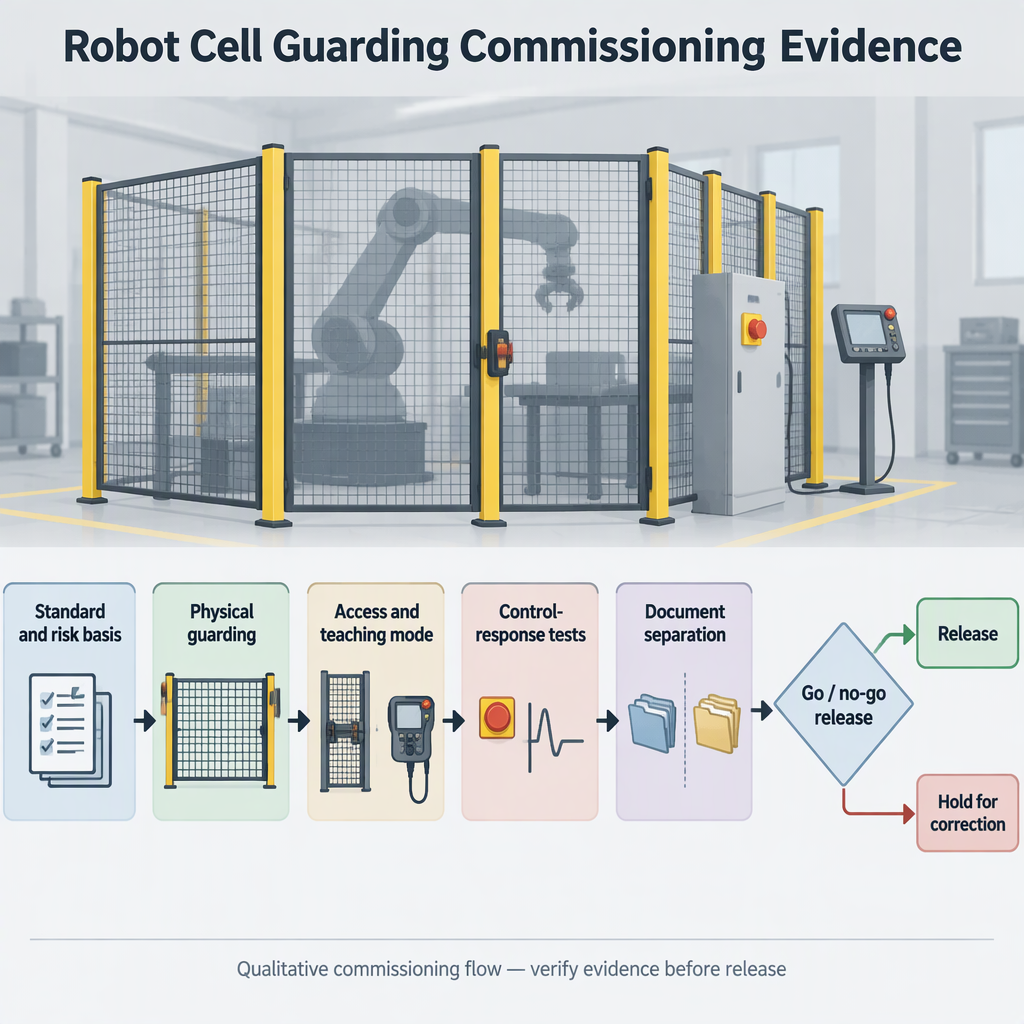
| Evidence item | What the integrator should verify | Commissioning decision |
|---|---|---|
| Guard-door state | Opening a guarded access point causes the expected protective response and prevents unintended restart. | Release only after the response and reset logic are recorded. |
| Protective-device response | Light curtains, motion sensors, floor sensors, or equivalent backup devices respond in the intended zone when used in the design. | Hold release if the response is undocumented or bypassed. |
| Emergency stop and hold | Emergency-stop and hold functions are tested in realistic operator and maintenance positions. | Release only when tests are recorded and repeatable. |
| Drive or motion feedback | The control record shows the robot state during entry, teaching, recovery, and restart. | Escalate if the interface cannot prove the safe state used for access. |
- List each safety-related input, output, and feedback signal used by the cell.
- Run each test from the operator side and, where permitted, from the maintenance or teaching position.
- Record the observed result, reset rule, responsible reviewer, and date in the commissioning file.
- Separate functional production trials from safety-response tests so a successful weld, handling, or tending cycle is not mistaken for a guarding sign-off.
Separate product claims, test files, precautions, and destination rules
A clean commissioning file separates what the product or system is claimed to include, what was actually tested, what users must do during operation, and which destination-market rules still govern acceptance.
| File category | Purpose | What not to mix into it |
|---|---|---|
| Product or system claim | Describes the supplied robot, guarding, control interface, and integration scope. | Do not add unverified certification, audit, cycle-time, accuracy, or productivity claims. |
| Commissioning test file | Records guard, interlock, protective-device, emergency-stop, entry-mode, and restart-response tests. | Do not use a production trial as a substitute for safety-response evidence. |
| Operating precautions | Tells operators and maintenance staff how to enter, supervise, hold, power down, or use reduced-speed modes where the project procedure permits. | Do not use precautions to justify bypassing guards or omitting training. |
| Destination rules | Identifies the adopted standard edition, local law, customer safety specification, and acceptance authority for the installation location. | Do not assume that one country’s reference package automatically satisfies another destination’s legal requirements. |
- Ask the supplier or integrator for the risk assessment, safety circuit description, commissioning test record, user precautions, and destination compliance file as separate documents.
- Require current edition references for any standard named in the file.
- Keep competitor product pages, catalog claims, and example applications out of the evidence file unless they are only being used for non-binding comparison of application ideas.
Use go/no-go checks before commissioning release
Stop commissioning release when guarding, access control, training, supervision, or documented safety response is incomplete, because unresolved safety gaps should be corrected before routine operation.
| Condition found | Release decision | Buyer action |
|---|---|---|
| Gate interlock, backup protective device, or emergency stop is not tested or the result is unclear. | No-go | Repeat the test, correct the circuit or logic, and update the record. |
| Pinch points or insufficient clearance remain reachable during expected tasks. | No-go | Revise guarding, tooling, fixture layout, or access procedure before release. |
| Entry, teaching, recovery, or maintenance procedure depends on informal supervision only. | No-go | Define the permitted mode, isolation step, supervision rule, and training requirement. |
| The standard edition or destination acceptance rule is not identified. | Hold | Confirm the applicable edition and local requirements with the customer, authority, or qualified safety professional. |
Conclusion
Robot cell safety guarding is ready for commissioning only when the physical guarding, controlled entry modes, safety-response evidence, training basis, and destination-rule file are aligned.
- Verify the standard edition and local rule boundary before judging the hardware.
- Test guards, interlocks, protective devices, stop functions, and restart behavior as safety evidence, not as production output.
- Keep product claims, test records, operating precautions, and destination compliance decisions in separate files.
FAQ
These questions help CNC integrators, machine-tool retrofit teams, and robot application engineers turn the guarding review into a practical commissioning checklist.
What is robot cell safety guarding?
It is the combination of barriers, access control, protective devices, safe entry procedures, training, and documented response tests used to reduce exposure to robot movement and related cell hazards.
Is a perimeter fence enough for commissioning?
No. The fence must be evaluated with interlocked gates, pinch-point controls, clearance, backup protective devices where appropriate, illumination, movement-zone marking, and the actual work sequence.
When should power be isolated before entering the cell?
Before manual access for clearing, cleaning, adjustment, troubleshooting, or maintenance, switch off and disconnect or isolate the applicable power sources, follow the site lockout procedure, and use only the access method allowed by the model manual and project safety file.
Which standard edition should be named in the file?
Name the edition adopted for the project and destination market. A3 identifies the 2025 ANSI/A3 R15.06 package and its relationship to ISO 10218-1:2025 and ISO 10218-2:2025, but the commissioning file should still confirm the actual edition and local adoption status.
What control-interface evidence matters most?
Record the guard-door state, protective-device response, emergency-stop or hold response, reset and restart rule, and the robot or drive state used during access and teaching.
Can a successful production trial prove the cell is safe?
No. A production trial may show that the process runs, but commissioning also needs separate evidence that guarding, access, stop, reset, and supervised entry functions respond as intended.
How should regional rules be handled for export or multi-site projects?
Treat regional rules as a separate acceptance item. Confirm the destination country’s adopted standards, customer safety specification, and authority requirements instead of assuming that one reference package applies everywhere.


