CAD-based offline programming
Use this as the starting point when reliable CAD geometry and stable fixturing can define the weld path before the robot is used for confirmation.

Views: 0 Author: Site Editor Publish Time: 2026-12-02 Origin: Site


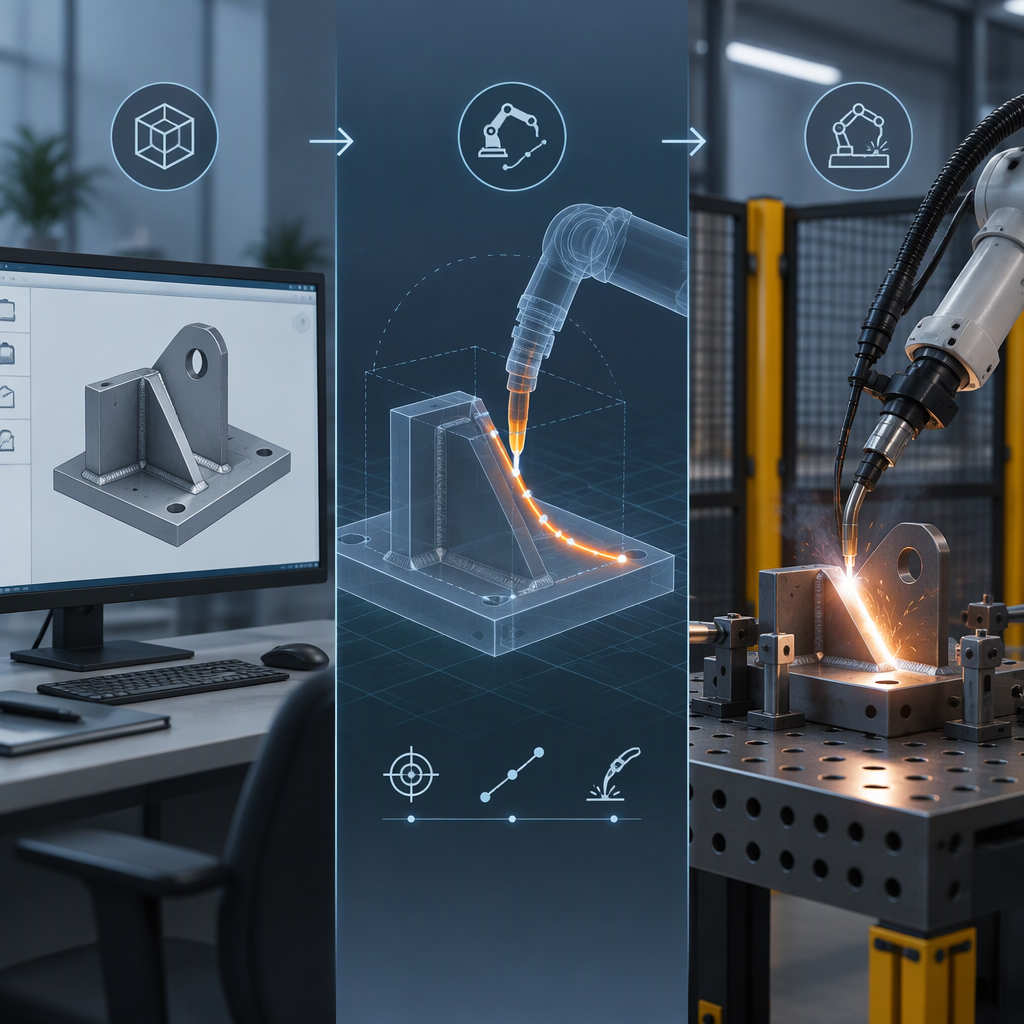
Offline programming for robotic welding means generating a robot program without using the real robotic system as the programming station.
In practice, robot welding offline programming can use CAD-based methods, vision-based methods or a combination of both. A peer-reviewed robotic welding study in Robotics and Computer-Integrated Manufacturing describes CAD-based and vision-based offline programming approaches and explains why complex or diverse workpieces may need hybrid methods to handle assembly deviations and path compensation.
For an integrator, that definition matters because the programming task is not only drawing a torch path. The project still has to connect nominal geometry, fixture reality, robot reach, weld sequence, torch access, controller output and commissioning feedback into one usable process.
Offline programming is worth evaluating when the cost of stopping the welding robot for programming, or the complexity of generating repeatable weld paths manually, is high enough to justify digital preparation and validation.
| Project signal | Why it points toward offline programming | Buyer check |
|---|---|---|
| Many weld paths can be derived from CAD geometry. | CAD-based offline work can turn digital part data into an initial program away from the real cell. | Confirm CAD quality, coordinate systems, fixture datums and how the post-processed path will be proven on the real robot. |
| Parts vary after assembly or fixturing. | Vision-based or hybrid methods may be needed where deviations require sensing or path compensation. | Ask what variation is measured, where the correction is applied and how bad parts are handled. |
| The welding cell will run multiple product variants. | Offline preparation can be more useful when repeated manual teaching for diverse workpieces becomes a bottleneck. | Group parts by similarity before assuming one programming workflow fits every variant. |
Do not treat offline programming as an automatic productivity or quality upgrade. The business case depends on part repeatability, available digital data, sensing needs, controller compatibility and the amount of on-site correction still required.
Online teaching or a light hybrid workflow may be enough when the workpiece is simple, stable and rarely changed, or when the real fixture variation dominates the digital model.
| Approach | Best fit | Limit to confirm |
|---|---|---|
| Online teaching | Stable, low-variation work where direct robot teaching is not a major bottleneck. | Robot downtime during teaching and the repeatability of operator-taught paths. |
| Offline programming | Projects where CAD data can support program generation before the real cell is available. | Accuracy of the model-to-cell relationship and the post-processor path. |
| Hybrid commissioning | Projects where CAD provides a starting path but sensing or shop-floor adjustment is needed for assembly deviations. | How measurement data, path compensation and final touch-up are controlled. |
If the part is repaired, distorted, hand-fitted or inconsistently clamped, the buyer should not assume a CAD-only workflow will be sufficient. The practical question becomes how much sensing, touch-up and controlled commissioning remain after the offline program is generated.
Choose the programming method by asking where the welding path uncertainty comes from: the digital model, the real assembled part, or the difference between the two.
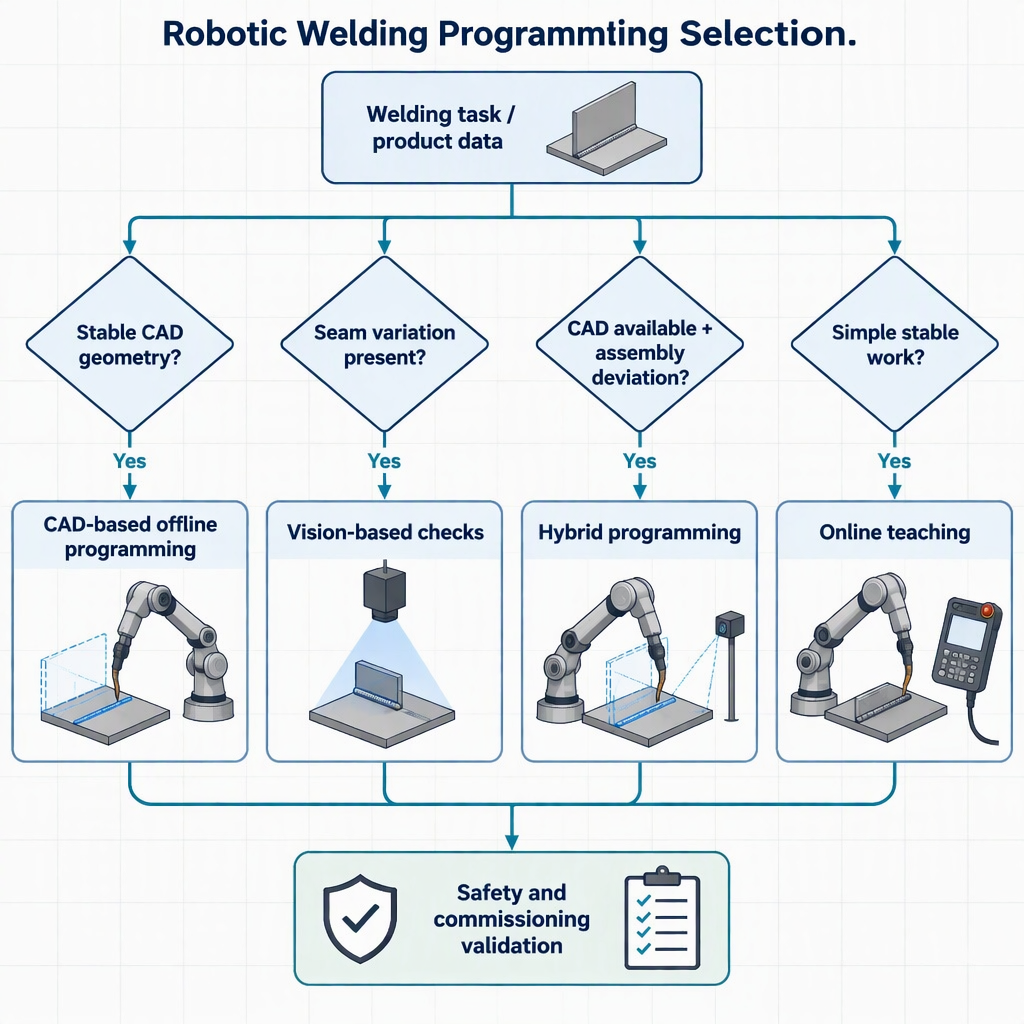
Use this as the starting point when reliable CAD geometry and stable fixturing can define the weld path before the robot is used for confirmation.
Consider this when the project needs workpiece observation to locate seams, deviations or features that cannot be trusted from nominal data alone.
Evaluate a hybrid method when the CAD model is useful but the assembled workpiece still needs path compensation because real parts deviate from nominal geometry.
| Variation source | Likely programming direction | What to ask before quotation |
|---|---|---|
| Nominal model is reliable | CAD-based offline path generation may be practical. | Which CAD formats, coordinate references and controller outputs are required? |
| Seam position changes on real parts | Vision-based correction may be required. | What sensor data is captured, and how is it converted into a corrected robot path? |
| Model exists but assembly deviation is expected | A hybrid CAD/vision process may be more appropriate than either method alone. | Where is the correction applied: before welding, during path generation or during commissioning? |
Before asking for a quotation, prepare data that lets the supplier judge geometry, variation and programming method. If the discussion involves SZGH, keep the confirmed scope to product categories shown on its first-party site, such as CNC machines, industrial robot arms, controllers, servo drives, servo motors, robot controllers and CNC plus robot integration categories including welding robots.
Offline programming can move path preparation away from the robot, but the physical welding cell still needs safety review, controlled commissioning and production validation.
A simulated path does not make the cell safe by itself. The buyer should confirm guarding, emergency stops, access control, teach-mode procedure, fume and arc-flash controls, and local regulatory requirements with the responsible safety team.
NIOSH’s Center for Occupational Robotics Research frames workplace robotics around injury monitoring, risk profiles and safe human-robot interaction.
NIST’s historical Industrial Robotics Standards publication is useful only as background that robot performance and safety standards have long been discussed; buyers should use current adopted standards and local rules for project compliance decisions.
General offline-programming theory explains how programs may be generated from CAD, vision or hybrid methods. Supplier capability must still be checked against the actual robot, controller, feedback and integration scope offered for the project.
Do not infer a named offline-programming package, supported post-processors, simulation accuracy, cycle-time improvement, delivery time or safety certification unless the supplier provides project-specific documentation for those claims.
Evaluate offline programming when digital preparation can realistically reduce dependence on teaching at the physical robot while still allowing compensation for real workpiece variation. Keep safety and commissioning validation in the project plan.
For CNC equipment integrators, machine-tool retrofit teams and robot application engineers, the best next step is to define the workpiece family, variation source, controller interface and safety-validation plan before comparing software or asking for a robotic welding quotation.
Most buyer questions come back to the same issue: whether the real cell will match the assumptions used to generate the offline program.
No. Offline programming can help generate programs away from the real system, but productivity and weld quality still depend on part repeatability, compensation method, controller execution, welding parameters and commissioning discipline.
No. It can reduce some teaching work, but real robot reach, fixtures, torch clearance, seam tracking, I/O timing and welding trials still need controlled on-site validation.
It is risky when assembled parts deviate from nominal CAD geometry, because the generated path may need sensing, compensation or manual correction before welding.
A hybrid method is worth considering when CAD data gives a useful starting path but real workpieces need observed correction because of assembly or fixturing variation.
Prepare part drawings, CAD files, weld seam lists, variation limits, fixture details, robot/controller requirements, line-interface requirements, commissioning responsibilities and safety expectations.
No. Robot cells still require risk review, safe human-robot interaction planning and validation before production, even if much of the path preparation happens away from the robot.
Compare the proposed programming method against the part variation problem. Then confirm the supplier’s actual controller, robot, feedback, integration, commissioning and documentation scope for the project.


2026-07-23 1156
SZGH-Technology-Full-Product-Catalog-Robots-CNC-Automation-2026.pdf
2026-06-18 46
SZGH CNC Milling Controller Catalog.pdf.pdf
2026-06-17 8
SCARA Robot White Paper.pdf
2026-06-11 30
SZGH-Collaborative-Robot-Cobot-Catalog-BCi-Series.pdf
2026-06-10 81
Shenzhen Guanhong Technology - Servo Motor Brochure 2025.4.pdf
2026-05-11 57
CNC MACHINE TOOL CATALOG.pdf


