Lower-risk retrofit candidate
The machine’s mechanical condition is known, the intended function remains similar, and safety controls can be reassessed without redesigning the whole production cell.

Views: 0 Author: Site Editor Publish Time: 2026-11-24 Origin: Site


Compare a CNC retrofit and a new machine under the same part mix, quality target, safety boundary, integration scope and acceptance tests. A retrofit becomes a higher-risk project when it changes the machine’s control method, function, safety strategy or assembly boundary. Control interfaces, G-code portability, proprietary limits and feedback pathways should be checked before cost or downtime numbers are trusted.
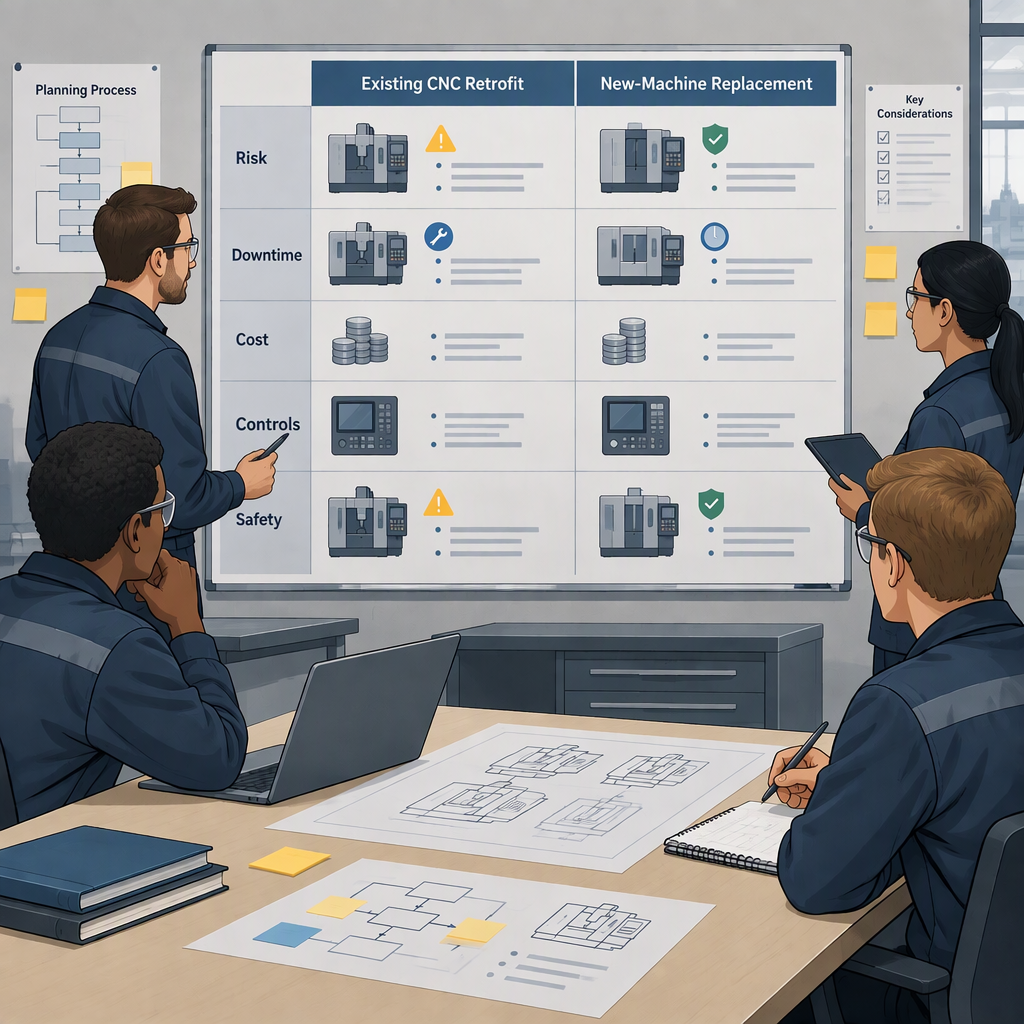
A fair CNC retrofit vs new machine comparison starts with one operating baseline: the same workpieces, tolerance expectations, operator model, automation scope, safety review, quality checks and cost categories.
NIST describes smart manufacturing work around measurement science, standards, test methods, interoperability, safety, performance, quality and cost; that is a practical frame for avoiding one-sided comparisons between an upgraded asset and a replacement asset.
Retrofit risk rises sharply when the project moves from replacing worn or obsolete components to changing machine function, control method, safeguarding strategy or the machine assembly itself.
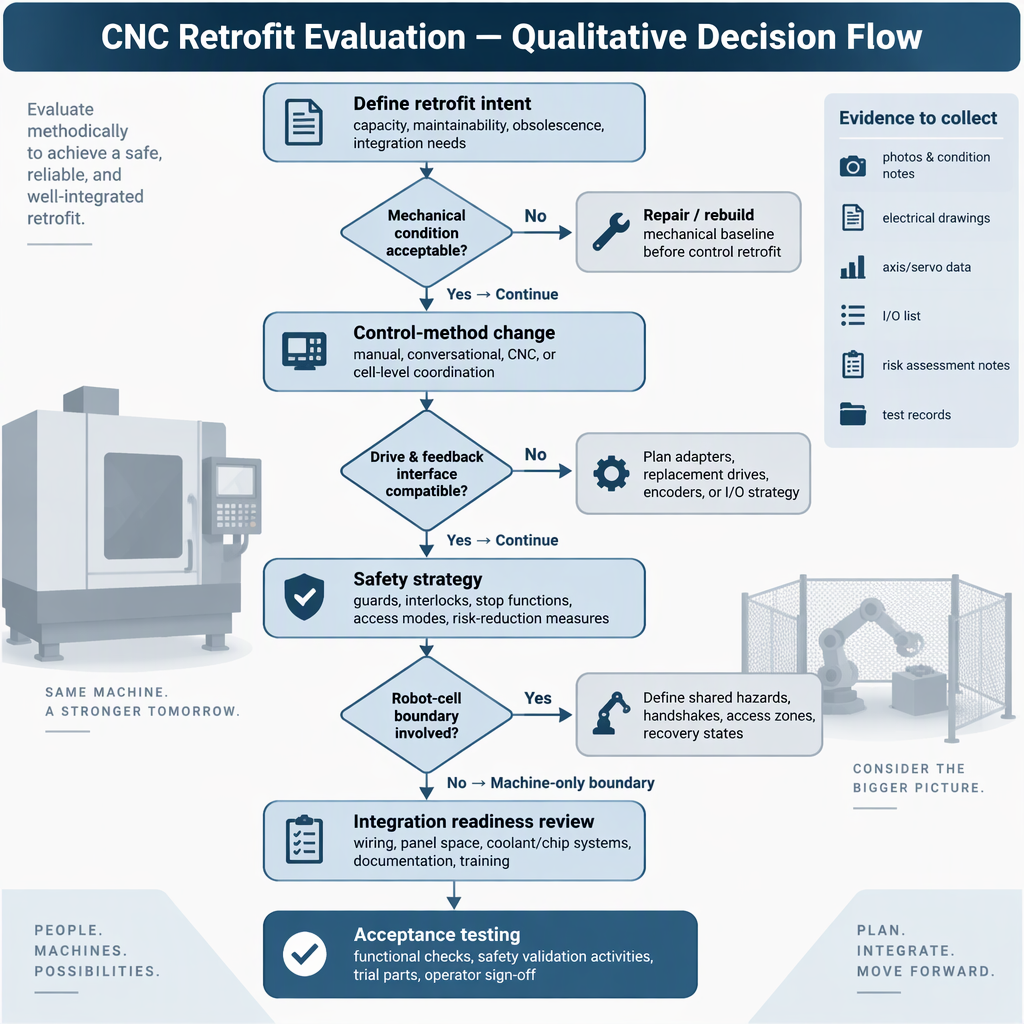
The machine’s mechanical condition is known, the intended function remains similar, and safety controls can be reassessed without redesigning the whole production cell.
The project changes the control method, function, safety strategy or machine assemblies so extensively that the work resembles a newly supplied machine or a new integrated system.
Treat safety and compliance as decision boundaries, not paperwork after the order. The UK Health and Safety Executive’s guidance on refurbished and modified machinery gives CNC control added to a previously manual machine as an example of a change that can substantially alter operation and introduce significant new risks. Apply the same principle with the rules adopted in the machine’s operating jurisdiction.
A retrofit is technically feasible only if the controller, drives, feedback signals, programs and external data interfaces can be made to work as one controlled process.
A peer-reviewed review of integrated CAM/CNC control systems notes that G-code is widely used, vendor-specific dialects and post-processors can limit portability, many commercial CNC systems are proprietary, and feedback routes such as MTConnect or OPC UA may be separate from command pathways.
| Check | Retrofit question | New-machine question |
|---|---|---|
| Program portability | Will existing part programs, macros and post-processors run without uncontrolled edits? | Will the supplied control accept the shop’s programming workflow and CAM post? |
| Drive and feedback data | Can servo, spindle, encoder, alarm and diagnostic signals be accessed at the needed level? | Are feedback and diagnostics exposed for integration, not only local operation? |
| Command versus monitoring paths | Are command pathways and monitoring pathways compatible, or only loosely connected? | Does the machine architecture support the intended supervisory or cell-control model? |
| Proprietary limits | Which parameters, safety functions and real-time data are locked by the existing architecture? | Which interfaces are documented for integrator use before purchase? |
Adding a robot turns the comparison from a machine decision into a cell-boundary decision because human-robot interaction, access, guarding, recovery and task handoff must be assessed together.
Shenzhen Guanhong Technology Co., Ltd. presents CNC machines, industrial robot arms and CNC + Robot Integration as product or solution areas, so integrators evaluating this type of supplier should request the cell-level interface, guarding and commissioning scope rather than comparing only machine hardware.
NIOSH describes occupational robotics safety work around robot-related injury trends, workplace risk profiles, safety standards support, and guidance for safe human-robot interaction. Use that lens when the retrofit includes robotic tending, palletizing, inspection or other automated cell tasks, and confirm the applicable local rules for the operating site.
Do not compare downtime as a single guessed number; compare the work packages that remove the asset from production and the validation milestones that return it to controlled production.
| Downtime work package | Retrofit path | New-machine path |
|---|---|---|
| Site preparation | Cabinet, wiring, drive, control and guarding work may be performed around an existing foundation and utility layout. | Foundation, rigging route, utilities, coolant, chip handling and cell layout may need fresh preparation. |
| Controls integration | Program conversion, parameter mapping, feedback checks and drive tuning can be the critical path. | Programming workflow, post-processor fit and external data links still need confirmation. |
| Safety validation | Modified controls, function or guarding may trigger reassessment before production release. | The new installation still needs site-specific risk review and safe integration into the production environment. |
| Production proving | Run the agreed parts, inspection plan and operator tasks before accepting the asset back into production. | Use the same parts, inspection plan and operator tasks so acceptance is comparable. |
A credible cost model includes machine hardware, controls, drives, feedback, software, safety engineering, robot integration, commissioning, training, spare strategy and lost-production exposure.
| Cost category | Retrofit question | New-machine question |
|---|---|---|
| Control architecture | What is required to connect the new control to existing motors, drives, feedback and programs? | What is included for documented interfaces, program migration and external data access? |
| Safety engineering | What risk assessment, guarding review, validation and documentation work is included? | What site-specific safety integration is excluded from the machine purchase price? |
| Quality and performance validation | Which acceptance parts, inspection methods and process capability checks are included? | Which same acceptance parts and inspection methods will prove the replacement asset? |
| Robot or cell integration | Are loading, unloading, human interaction, fault recovery and guarding changes included? | Is the robot cell supplied as a complete integrated boundary or as separate equipment? |
Avoid percentage savings, payback periods or generic price ranges unless they come from the actual supplier quote and measured site baseline. For a fair RFQ, ask both retrofit and new-machine suppliers to price the same scope, exclusions and acceptance tests.
Accept either path only after measured checks prove safety functions, program execution, feedback behavior, part quality, operator tasks and cell recovery under the agreed production conditions.
| Acceptance result | Decision action |
|---|---|
| Programs run but feedback integration is incomplete | Hold acceptance until interface limits are resolved or the integration scope is reduced. |
| Safety review identifies a changed machine function or access hazard | Treat the safety reassessment as part of the project scope before comparing final cost. |
| Quality checks pass under the agreed part mix and inspection method | Compare lifecycle cost, maintainability and integration support rather than purchase price alone. |
Choose the path with the lower total execution risk after mechanics, controls, safety, integration, downtime work packages and acceptance evidence are compared on the same basis.
The base machine is mechanically serviceable, the production task is stable, and the control or drive update does not create a broad change in function, safety strategy or cell boundary.
The existing programs, drives, feedback signals and data interfaces can be mapped with manageable technical risk.
The project requires a major control-method change, new safeguarding concept, new machine assembly or extensive robot-cell redesign.
The buyer needs a clean baseline for performance, quality, maintainability and integration measurement rather than rebuilding an uncertain asset.
The better option is not the cheaper quoted line item; it is the option that proves the required production result with acceptable safety, interface, downtime and validation risk.
If the existing machine is sound and the retrofit scope is bounded, retrofit can be a rational engineering project. If the project changes the control method, safety strategy, robot-cell boundary or acceptance risk too broadly, evaluate a new machine on the same measured conditions before committing.
Before choosing, answer these practical questions with supplier documents, site measurements and acceptance tests rather than assumptions.
No. Compare the full scope: hardware, controls, drives, feedback, safety engineering, integration, commissioning, training, validation and production interruption. Without the same cost categories, the lower initial quote can be misleading.
Break downtime into work packages: removal from production, installation, controls integration, safety validation, production proving and operator release. Ask each supplier to attach assumptions and exclusions to each package.
Common risks sit in program portability, proprietary controller limits, drive and feedback compatibility, and the separation between command pathways and monitoring data pathways.
Use deeper reassessment when the project changes machine function, control method, safety strategy, access points or the machine assembly. Confirm the applicable obligations with the authority and rules for the operating location.
Robot loading adds human-robot interaction, task handoff, fault recovery, access and guarding questions. Evaluate the complete cell boundary rather than the CNC and robot as isolated purchases.
Request the integration scope, interface list, safety validation plan, commissioning plan, acceptance test matrix, exclusions, training scope and support boundaries for both retrofit and new-machine proposals.
Run the agreed parts, inspection plan, operator tasks, alarms, recovery steps and data interfaces under the agreed production conditions. Accept the project only when those checks match the purchase scope.


2026-07-23 1156
SZGH-Technology-Full-Product-Catalog-Robots-CNC-Automation-2026.pdf
2026-06-18 46
SZGH CNC Milling Controller Catalog.pdf.pdf
2026-06-17 8
SCARA Robot White Paper.pdf
2026-06-11 30
SZGH-Collaborative-Robot-Cobot-Catalog-BCi-Series.pdf
2026-06-10 81
Shenzhen Guanhong Technology - Servo Motor Brochure 2025.4.pdf
2026-05-11 57
CNC MACHINE TOOL CATALOG.pdf


