


A CNC retrofit is ready for production release when the installation-dependent inspection has actually been carried out and recorded — not when the first test part measures correctly. That record only closes the loop if the machine is complete, stable in its final position and fitted with every safeguard, and if the residual risks passed on by the equipment supplier are understood and controlled by the people who now run it.
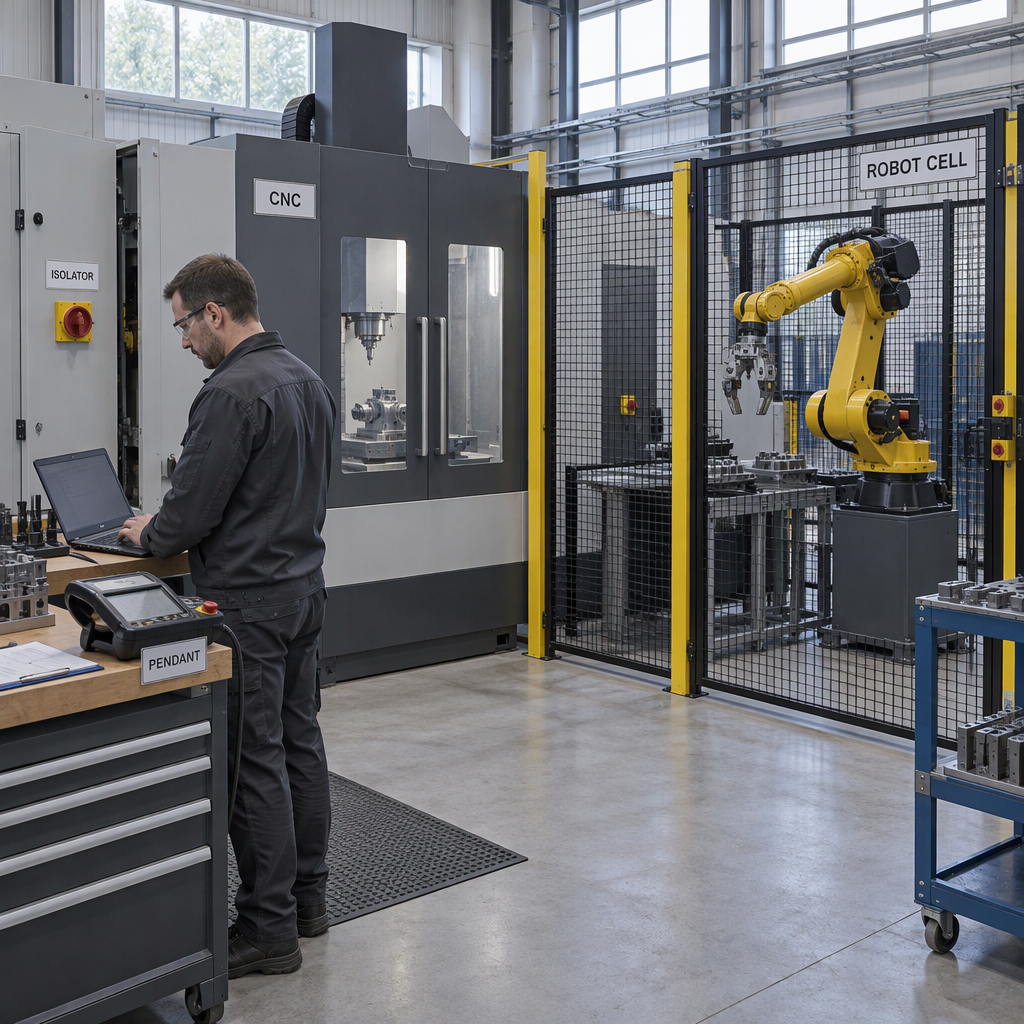
What Does Commissioning a CNC Retrofit Actually Cover Before Release?
Commissioning covers four things, and it ends only when all four are evidenced: every interface from the incoming supply to the finished-part handshake, the machine's installation and stability in its final position, the control programmes and safeguards behaving as intended, and a record showing each was checked. Release is a documented handover, not the moment a good part comes off the machine.
Work equipment must be suitable and safe, inspected to confirm correct installation, and fitted with clearly identified start, stop and control devices plus, where appropriate, suitable means of isolating it from every energy source — electric, hydraulic, pneumatic and gravitational. A retrofit that passes a geometry test but leaves an unlabelled control, a missing guard or an unreachable isolation point has not been commissioned.
Which Upstream and Downstream Interfaces Should Be Mapped First?
Map the interfaces before power-up, because a retrofit's weakest points sit at the boundaries between subsystems. Build one register covering both directions — incoming electrical and fluid supplies, safeguarding and stop circuits, the CNC-to-robot handshake, and the program and data path — with an accountable party and acceptance evidence against every line.
| Interface | Record before power-up | Who confirms it | Acceptance evidence |
|---|---|---|---|
| Incoming electrical supply | Voltage, phase, frequency, protective devices, earthing, and reachable means of isolation | Site electrician with the retrofitter | Supply test record and single-line diagram |
| Fluid and pneumatic services | Incoming hydraulic and pneumatic risks, pressure and flow at the machine, filtration and drains | End user utilities with the integrator | Measured supply at the machine |
| Safeguards, interlocks and stops | Guard completeness, interlock type and reset behaviour, and marked emergency stops within easy reach | Retrofitter, integrator, end user | Function test of every interlock and emergency stop |
| CNC-to-robot handshake | Permissive, cycle start, gripper, part-present, fault and reset signals, with names and addresses | Integrator | Signal-by-signal I/O trace, robot in a safe state |
| Program and data path | Transfer route, offsets and tool data, network addressing, and who may change control programmes | Integrator with production engineering | Transfer test and dated change record |
What Installation, Space and Utility Conditions Need Confirming On Site?
Confirm three things before any powered test: the machine is installed properly and stably — usually fixed down — in the position the design assumes; every service connection is made, tested and marked; and people can reach the isolation points, service points and guard doors. A static machine that is not fixed down moves under cutting and indexing forces, and a clearance that exists only on the drawing does not exist on the floor.
- The machine is complete: every guard and safeguard fitted and free from defects before testing starts.
- Final position matches the foundation or floor-load plan, and the machine is fixed down and re-levelled after any move.
- After reassembly at a new site or a major modification, an inspection is scheduled before the machine returns to use.
- Clearances are checked on the floor, not the drawing: guard doors, tool change, chip and coolant paths, and the robot's reach envelope.
- Electrical connection is complete, protective devices and earthing are in place, and the means of isolation is reachable from outside the guarded area.
- Fluid, hydraulic and pneumatic services are connected, leak-tested and marked, and the risks those supplies create are identified and managed.
How Should Responsibility Be Split Between Retrofitter, Integrator and End User?
Split responsibility interface by interface, and write the split down before power-up. The Health and Safety Executive's introduction to machinery safety puts the duty on suppliers to provide the right safeguards and disclose the residual risks they leave behind; the party that controls the equipment at work must understand and manage those risks.
Retrofitter or machine builder
Owns the design intent, control architecture, guard layout and the definition of what the retrofit covers.
Supplies conformity documentation, instructions, residual-risk information and commissioning test records.
Boundary to state in writing: any function it did not design or verify, such as a third-party robot's internal safety functions.
Integrator
Owns the joints between subsystems: I/O handshakes, safety-circuit integration, the network plan and the cell cycle.
Supplies the interface register, signal and safety-function test records, and the program change log — changes made by a competent person, recorded and checked afterwards.
Boundary to state in writing: the agreed signal list, everything outside it, and who may edit programs after handover.
End user — the party controlling the equipment at work
Owns site conditions, utilities, the safe system of work, isolation procedure, operator competence and the inspection regime.
Supplies the inspection record, acceptance signature, training records and isolation procedures; a new control is a training trigger, because needs are greatest when new equipment is introduced.
Boundary to state in writing: the residual risks it accepts, and any modification made after handover.
Keep the manufacturer's paperwork with the register: SZGH states that it manufactures CNC machines and industrial robot arms and develops the controllers, servo drives and robot controllers inside them. Its about page also declares conformity to EN 60204-1, EN ISO 12100 and EN ISO 16090-1 under CE certificate no. EBO2307022-V060. Ask for the certificate and declaration that match the exact delivered configuration, including any robot, safety option or fieldbus module added on site.
How Do You Prove Safe Isolation and Stored-Energy Control Before the First Motion Test?
Before anyone reaches into the machine, stop it, switch off and disconnect the applicable power supplies, and lock off the point where power could be switched back on. Then release stored energy — bleed compressed air, discharge hydraulic accumulators, support or lower gravity-loaded axes — and confirm that state at the machine before manual access. A stop command on the pendant is not an isolation step, and following the manual's access procedure is not, on its own, an energy-isolation instruction. The isolation, lock-off and stored-energy controls in the Health and Safety Executive's guidance on maintenance of work equipment are the same ones the first motion test depends on.
- Moving plant has stopped and all drives are stationary before any guard is opened.
- Supplies are isolated at the machine's means of isolation and locked off so power cannot be switched back on.
- Pressurised fluid, gas or steam lines are isolated and de-pressurised before a connection is opened.
- Stored energy is released: air lines bled, accumulators discharged, and gravity-loaded axes supported or lowered to a safe resting position.
- The isolated state is confirmed at the point of work before anyone reaches in, and higher-risk work inside a robot's reach envelope runs under a permit-to-work system.
- To clear a jam or clean inside a powered machine, switch off, disconnect and lock off first, then use only the access route the machine manual permits — never remove a guard or defeat an interlock.
What Order Should the Commissioning Checks Follow?
Work in gate order and do not open the next gate until the previous one is signed off: interfaces, installation and utilities, isolation and safeguards, unloaded motion and programs, connected handshake, then release. Testing motion before isolation is proven puts people in the danger zone for no technical gain.
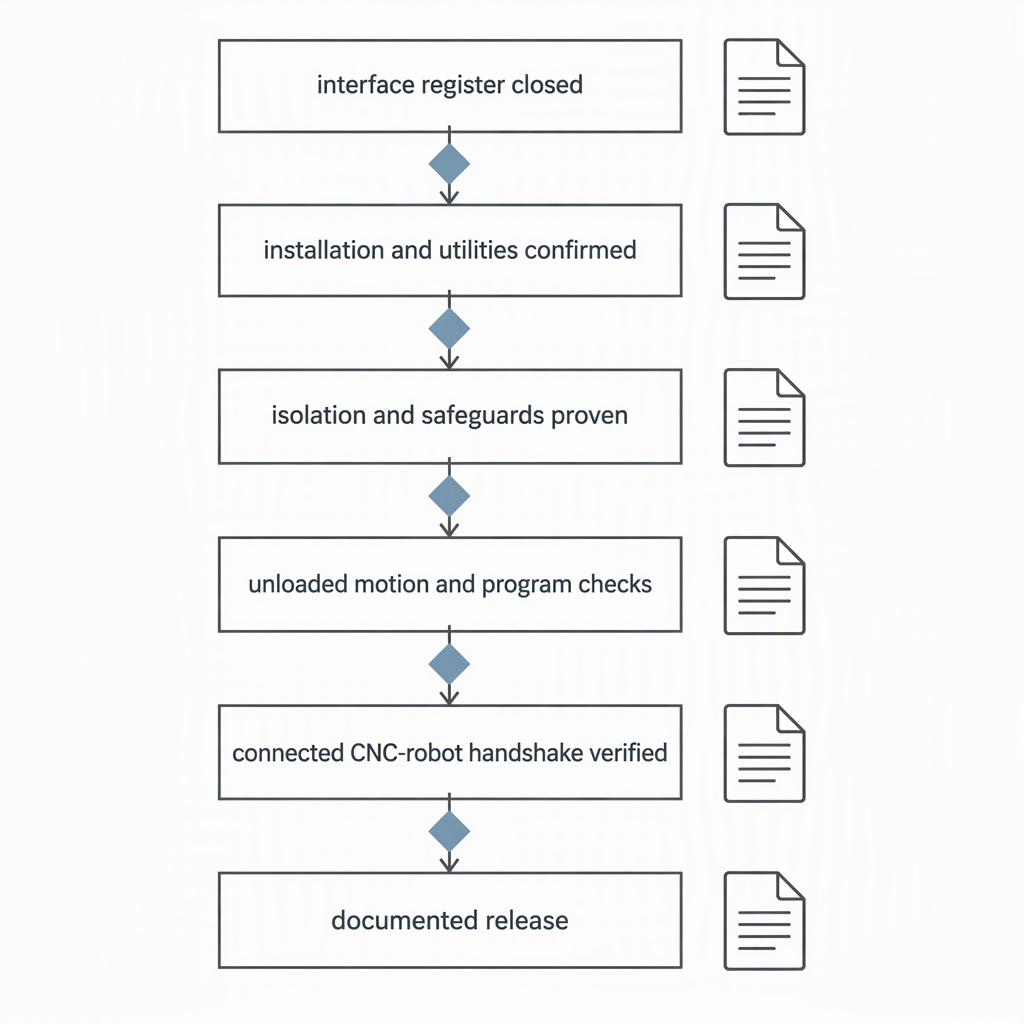
- Documentation gate: interface register complete, backups current, isolation points labelled, machine builder's instructions to hand.
- Installation gate: machine fixed down and stable, utilities leak-tested, guards complete, clearances confirmed on the floor.
- Isolation gate: power off and locked off, stored energy released, isolated state confirmed, then every interlock and emergency stop function-tested.
- Dry motion gate: axes referenced and jogged, soft limits verified, spindle and tool change checked unloaded to the builder's procedure.
- Program gate: dry-run and single-block checks, offsets verified, every change made by a competent person and checked afterwards.
- Handshake gate: CNC and robot connected, permissives toggled one at a time with the cell guarded, robot at reduced speed until each interlock is proven.
- Release gate: inspection recorded, training delivered, residual-risk acceptance signed, records filed with the machine.
Treat this as an engineering order rather than a single mandated procedure: your customer, your jurisdiction and the machine's own documentation decide what evidence is accepted.
How Do You Verify Programs and the CNC-Robot Handshake, Offline and Then Connected?
Test in two stages, never in production mode: prove the programs offline or in a dry run with motion disabled, then re-test the same logic connected and guarded at reduced speed, one signal and one cycle at a time. Every program change made here must be made by a competent person, recorded, and checked afterwards.
| Stage | What you observe | Pass condition | Record |
|---|---|---|---|
| Offline or dry run | Syntax, tool path, offsets and M/S/T sequence with motion disabled | Path stays inside the machine envelope, and tool and offset calls match the setup sheet | Program version, date, person, result |
| Guarded single block | Axis directions, reference positions, soft limits, spindle and coolant commands | Directions and limits match the machine documentation, and stop and feed-hold behave as designed | Per-axis test sheet |
| Connected handshake | Permissive, cycle start, gripper, part-present, fault and reset signals, one at a time with the robot guarded | The robot cannot enter the machine's operating space without the interlock permissive | I/O trace with signal names |
| Low-speed connected cycle | One full cycle at reduced speed without a production part, including stop and restart mid-cycle | Cycle completes without an unintended stop, and the cell reaches a defined safe state | Cycle log and any open defect |
| Change control | Every control-programme edit during commissioning, whoever made it and why | Made by a competent person, recorded and checked against the re-test | Change log and re-test result |
| Supervised production run | Parts produced under normal conditions with all safeguards intact | Parts meet the inspection level agreed with the customer | First-article record and acceptance signature |
What Evidence Should Exist Before the Retrofit Is Released to Production?
Release on evidence. The file must show the installation-dependent inspection record, the closed interface register, isolation and safeguard tests, the program change log, and the acceptance signature of the party that controls the equipment.
- The installation-dependent inspection has been carried out after installation and before first use, and recorded.
- The record is kept at least until the next inspection, with intervals set by a risk assessment that considers the manufacturer's recommendations.
- The interface register is closed, with a confirming party and the evidence on every line; open items carry a compensating control and a date.
- Isolation and safeguard tests are complete, covering the means of isolation, guards, interlocks and emergency stops.
- The program change log is complete, with each change made by a competent person and checked afterwards.
- Training is delivered and recorded for the new control, and maintenance is handed to people competent for that work.
Whatever format you use, the record has to answer a plain question: what was checked, by whom, and against what. The Health and Safety Executive's guidance on inspection of work equipment gives the triggers for equipment whose safety depends on installation conditions — installation and first use, reassembly at a new site, and major modifications — and says the result should be recorded and kept at least until the next inspection.
Conclusion
A retrofitted machine is releasable when the interfaces are closed and evidenced, the installation and isolation states are proven rather than assumed, every control-program change is recorded and checked, and someone who controls the equipment has accepted the residual risk in writing.
- Interfaces first: register every connection, name an owner for each line and attach acceptance evidence before power-up.
- Installation-dependent safety is what triggers the inspection duty — record the result and keep it until the next inspection.
- Isolation before access: switch off, disconnect and lock off the power, release stored energy, then confirm the state at the machine.
- Change control covers every program edit made during commissioning, however small the reason.
- Training and the maintenance regime are release items, not follow-up tasks.
Signing a retrofit over to production is a handover, not a formality: the signature says that the machine standing on the floor has been inspected after installation, and that the people who will run it know how to stop and isolate it.
Frequently Asked Questions About CNC Retrofit Commissioning
Most release disputes are about the record rather than the machine: who inspected it after installation, what was written down, and who accepted the residual risk. The answers below cover what comes up most often when a retrofitted CNC machine or a CNC-plus-robot cell is signed over to production.
Who should sign the release, and can the end user sign it alone?
Both sides. The duty to keep work equipment safe, to have it inspected where safety depends on the installation, and to give operators adequate information and training sits with the party controlling it, so end-user acceptance cannot be delegated to the installer. The installer must still supply the inspection results, test records and residual-risk information that the acceptance rests on.
Does the inspection duty repeat after a later modification or a move to another site?
Yes. The triggers are installation and first use, reassembly at a new site, intervals where deterioration could cause danger, and major modifications. Adding an axis, changing a guard or moving the machine restarts the cycle: inspect again and keep the record at least until the next inspection.
What operator training is needed when a retrofit introduces a new control?
Enough that operators can run the machine without unnecessary risk: start and stop, emergency stop and reset, guard and interlock behaviour, load and unload routines, error recovery, isolation points, and the parts of the cycle they must never intervene in. Training needs are greatest when new technology or equipment is introduced. Operators also need adequate information and training for the machine as it is actually installed.
How long must inspection and maintenance records be kept?
Inspection results should be kept at least until the next inspection. There is no separate legal requirement to keep a maintenance log, but an existing log must be kept up to date, and records are recommended for higher-risk equipment. Keep the release file for the life of the retrofit.
Can remote diagnostics replace the on-site verification step?
No. Remote parameter diagnostics can speed up fault-finding — SZGH states that it provides them with round-the-clock remote support — but remote tools report what the control believes is happening. They cannot confirm how the machine is fixed down, how the guards sit on this site, or whether isolation is reachable.
Does a retrofitted machine that goes back on the market raise product-supply questions?
It can. In Great Britain, the Health and Safety Executive groups refurbishing and second-hand supply with product and market-surveillance topics. Equipment supplied there must comply with product supply law, with conformity marking, a declaration of conformity and instructions in English. Whether a retrofit counts as supplying new machinery, as a substantial modification, or only as in-house use depends on the market, so confirm the destination market's requirements before the machine ships.
Who owns each interface when a third-party robot is bolted onto an existing CNC?
Whoever takes the risk should own the interface, and the split should be settled in writing before power-up. The supplier must fit the right safeguards and pass on the residual risks it leaves behind, which the organisation operating the cell must understand and control.


