Manual welding path
Use this path when work varies by geometry, access, repair condition, or sequence. The key question is whether skilled welders can handle the variation with acceptable quality and traceability.

Views: 0 Author: Site Editor Publish Time: 2026-12-10 Origin: Site


Robot welding is usually the option to validate when the part family is repeatable, the fixture and joint access can stay stable, and the project can support robot programming, guarding, integration, and safety review. Manual welding is usually the option to keep when the mix changes often, access is uncertain, batches are small, or the work still depends on skilled judgement. Compare both under the same part, joint, inspection, setup, rework, and staffing assumptions before choosing.
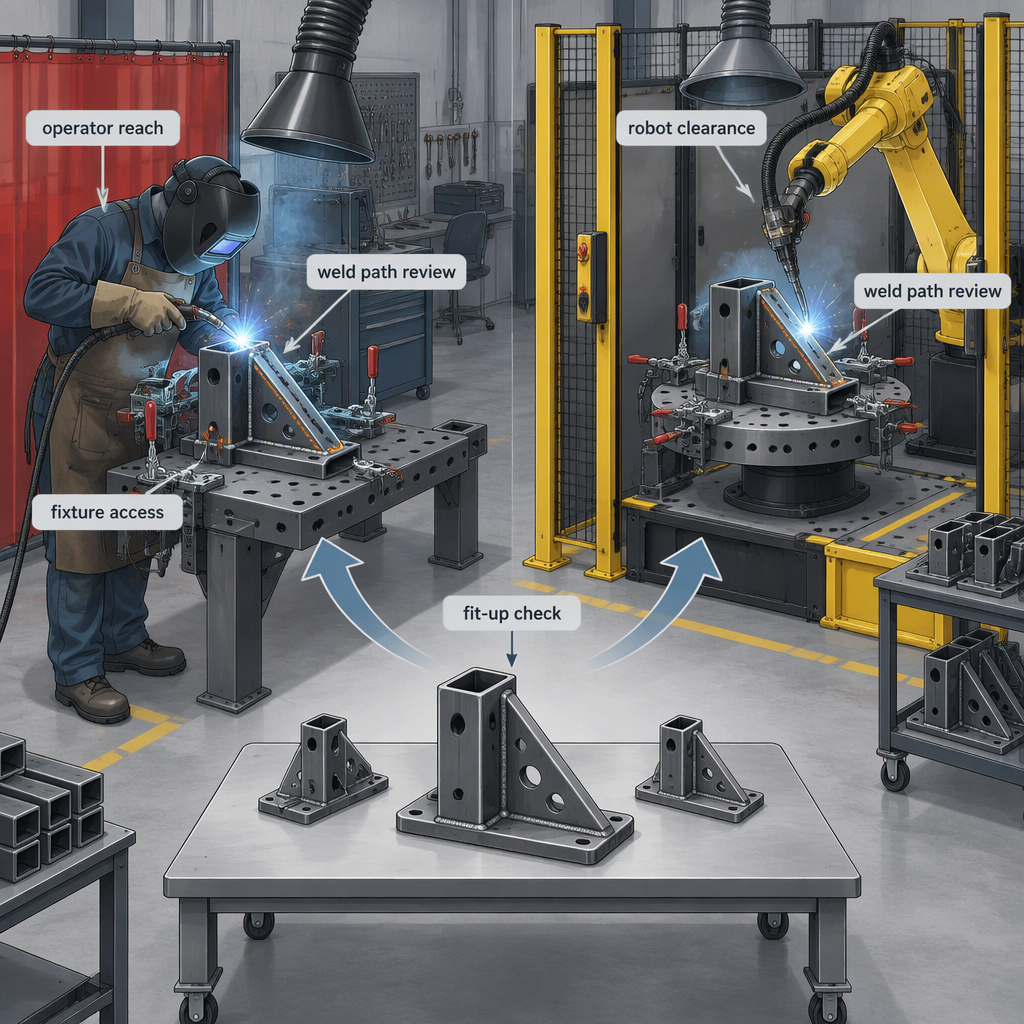
Use this path when work varies by geometry, access, repair condition, or sequence. The key question is whether skilled welders can handle the variation with acceptable quality and traceability.
Use this path when parts, fixtures, weld paths, and inspection rules can be repeated. The key question is whether the cell can be integrated, guarded, debugged, and supported through production changes.
A fair robot welding vs manual welding comparison uses the same workpiece family, weld definition, fixture concept, inspection rule, setup boundary, and rework policy for both options.
| Comparison item | Manual welding question | Robot welding question |
|---|---|---|
| Part mix | How often do geometry, thickness, access, or weld sequence change? | Can the part family be grouped into repeatable programs and fixtures? |
| Volume | Does the batch size justify skilled setup without excessive waiting? | Is the repeat volume enough to absorb programming, fixture, and cell setup work? |
| Weld access | Can a welder reach and see the joint consistently? | Can the torch path, angle, clearance, and approach be taught without collisions? |
| Quality rule | What inspection criteria, acceptance limits, and rework rules apply? | Can the same criteria be checked after automated passes and program changes? |
| Changeover | How much time is spent finding tools, drawings, tack points, and clamps? | How much time is spent loading fixtures, selecting programs, and confirming offsets? |
Manual welding fits best as the baseline to test when parts are irregular, batches are short, or the operation depends on human adaptation that has not yet been converted into fixtures, programs, and repeatable checks.
Robot welding becomes worth testing when repeat volume, stable fixtures, and teachable weld paths make automation supportable beyond the first demonstration part.
The NIOSH Center for Occupational Robotics Research frames robotics safety around workers who use, wear, or work near robots, including traditional industrial robots in cells or cages and newer co-existing technologies.
NIOSH also describes work on robot-related injury monitoring, robotic workplace risk profiles, and support for consensus safety standards, so a robot-welding decision should include the cell-risk review, not only arc time.
Do not calculate payback from robot price or labor rate alone; include setup, fixtures, programming, guarding, downtime, inspection, rework, training, and changeover for both choices.
| If the dominant cost is... | Check before choosing | Decision implication |
|---|---|---|
| Welder time on repeat parts | Measure cycle, fit-up, and rework on the same joint family. | Robot welding may deserve a controlled trial. |
| Engineering change and setup | Track how often drawings, fixtures, or sequence rules change. | Manual welding may remain more flexible. |
| Inspection and rework | Separate defects caused by skill, fit-up, access, or process instability. | Fix the root cause before assigning value to automation. |
| Downtime and support | Estimate who can troubleshoot programs, drives, controls, and safety devices. | Robot welding needs support capacity, not only equipment budget. |
For CNC retrofit and robot application teams, the robot-welding decision should include interface signals, motion coordination, drive feedback, fixtures, debugging access, and the safety architecture around the cell.
The comparison should treat robot hazards and welding-environment hazards as separate but connected workstreams: the cell must manage human-robot interaction while the welding area manages arc, fume, fire, ventilation, and related process risks.
NIOSH describes occupational robotics safety in terms of workers who use, wear, or work near robots, including traditional industrial robots in cells and cages.
The American Welding Society identifies AWS/ANSI Z49.1:2021, Safety in Welding, Cutting, and Allied Processes, as covering safety and health topics in the welding environment, including personnel protection, area protection, ventilation, fire prevention and protection, and confined spaces.
Use safety standards and regulator resources to shape the checklist, but confirm the adopted law, standard edition, local amendments, and site safety file for the country and plant where the welding system will operate.
Manual welding depends heavily on welder skill, while robot welding adds programming, technician, debugging, and safety-recovery skills that must be planned before production starts.
AWS identifies AWS D16.4M/D16.4:2025 as a specification for qualification of robotic arc welding personnel at Associate Technician, Technician, and Engineer classifications.
Choose after a controlled trial that measures the same part family, fixtures, weld criteria, setup time, rework rules, operator tasks, integration limits, and safety actions for both options.
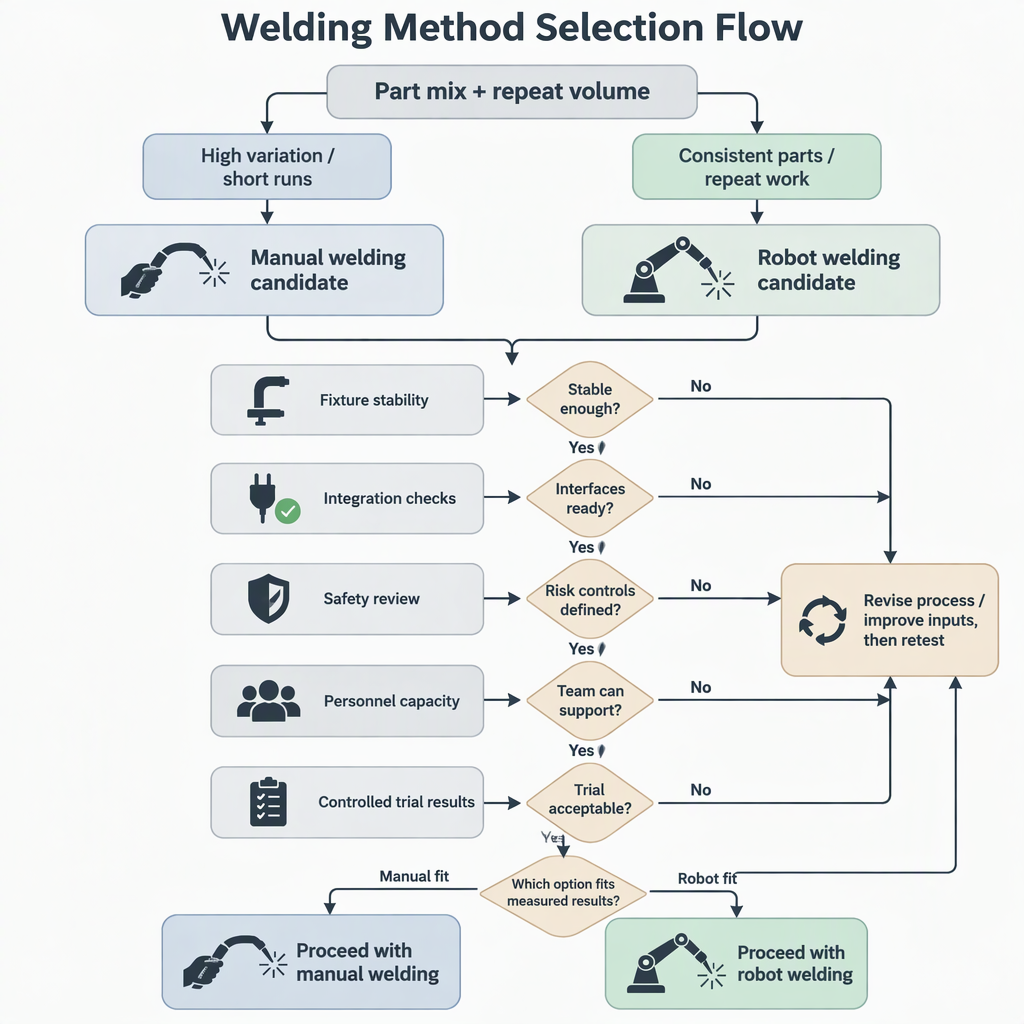
Robot welding is not automatically the better choice, and manual welding is not automatically the safer or cheaper choice; the better fit is the one that matches the part mix, repeat volume, integration capacity, safety requirements, and measured trial results.
These questions help narrow the welding choice after the main comparison table and trial plan are complete.
No. Robot welding may reduce repeated arc-path variation, but total time also includes loading, clamping, program selection, fault recovery, inspection, and changeover. Measure the whole cycle before making a speed claim.
Manual welding is usually better to keep when the part mix changes often, access is uncertain, fixture repeatability is low, or the work requires frequent human judgement during fit-up and repair.
Robot welding is usually better to test when batches repeat, fixtures are stable, weld paths can be taught, and the team can support programming, guarding, maintenance, and safe recovery.
Commonly missed items include fixture engineering, robot programming, guarding, safety validation, operator training, inspection changes, rework, spare parts, debugging time, and downtime during product revisions.
Interfaces matter: define signals, drive feedback, positioner coordination, robot reach, fixture status, fault recovery, and responsibility for program changes before equipment is purchased.
No. It changes the safety problem. The project still needs welding-environment controls, and it also needs robot-cell guarding, access control, safe recovery, and energy-isolation procedures.
Yes. Manual welding requires welding skill and inspection discipline, while robot welding adds programming, technician, maintenance, and safety-recovery skills. Treat those people requirements as part of the business case.


2026-07-23 1156
SZGH-Technology-Full-Product-Catalog-Robots-CNC-Automation-2026.pdf
2026-06-18 46
SZGH CNC Milling Controller Catalog.pdf.pdf
2026-06-17 8
SCARA Robot White Paper.pdf
2026-06-11 30
SZGH-Collaborative-Robot-Cobot-Catalog-BCi-Series.pdf
2026-06-10 81
Shenzhen Guanhong Technology - Servo Motor Brochure 2025.4.pdf
2026-05-11 57
CNC MACHINE TOOL CATALOG.pdf


