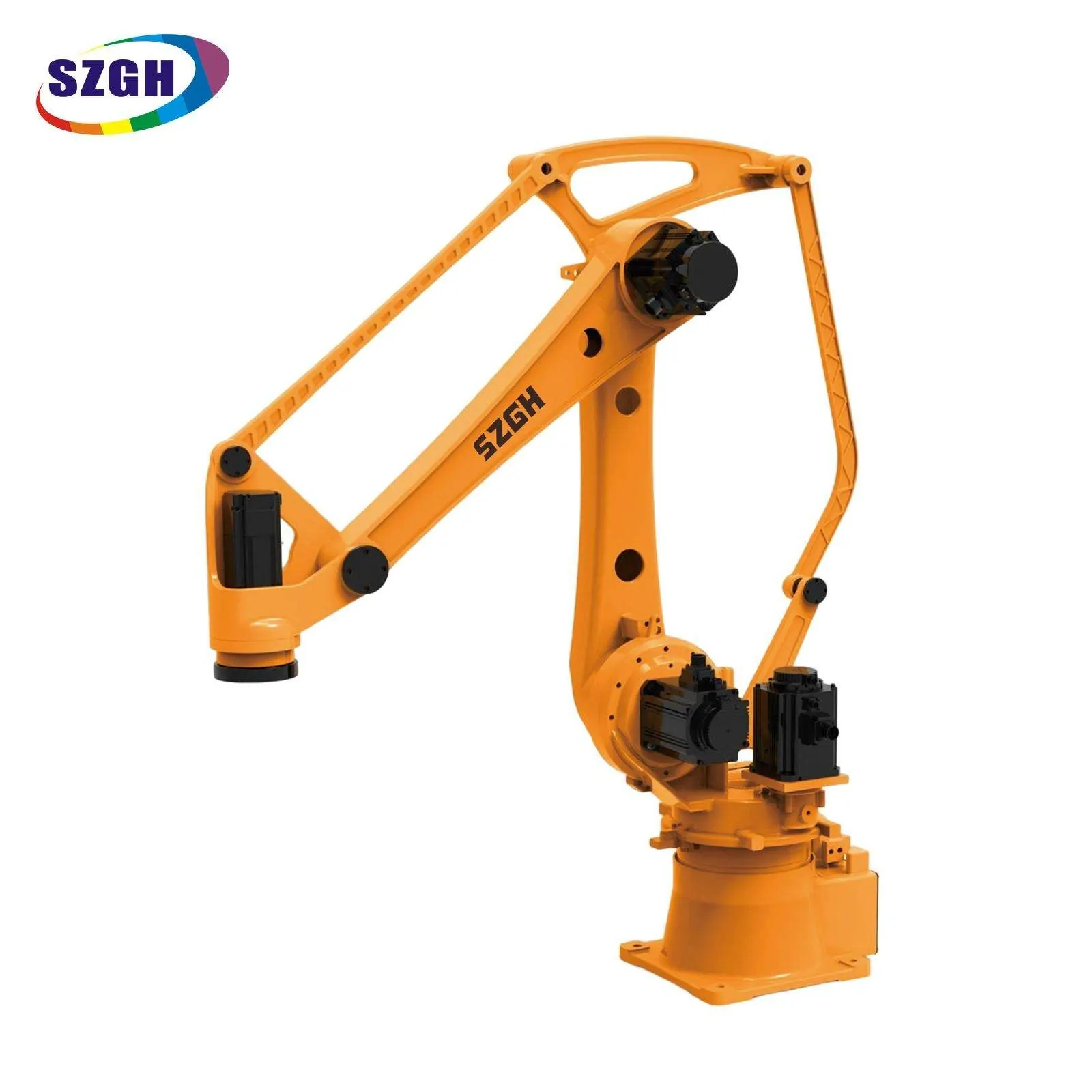
Food and beverage lines ask a different question than most of the factories I talk to. It's not just "can a robot lift this" — it's "can a robot keep up with a line that runs continuously, at high speed, without becoming the thing that slows everything else down." I've covered general selection in how to choose the right palletizing robot arm and carton-specific guidance in palletizing robot arm for carton boxes. This article is about what's specific to food and beverage packaging lines on top of that.
What makes food and beverage palletizing different
Most food and beverage palletizing involves cartons, cases, shrink-wrapped multipacks, or boxed products — which puts it in the easier category of palletizing applications from a gripper-design standpoint. But three things make this industry stricter than a typical carton line:
Continuous operation. Bottling and packaging lines are often designed to run with minimal stoppage across long shifts, so cycle time reliability matters as much as raw speed.
Line speed consistency. A robot that's fast on average but inconsistent will create bottlenecks upstream or downstream, even if its top-line spec looks impressive.
Packaging variety. A single facility often runs multiple SKUs — different case sizes, different multipack formats — through the same palletizing station, sometimes within the same shift.
None of this requires an exotic robot. It requires picking the right payload and reach for your actual case weight and pallet layout, and being honest about your real (not theoretical) line speed.
Matching robot capacity to case and carton weight
Beverage cases and food cartons typically fall in a moderate payload range — heavier than a light snack carton, lighter than a bag of chemical powder. From our SZGH-B Handling Series, two models cover most of this range:
As with any carton-style palletizing job, remember that your payload requirement includes the gripper weight, not just the case weight — if you're running a multi-cup vacuum head to hit higher throughput, that added tooling weight needs to be part of your sizing math, not an afterthought.
Gripper design for food and beverage packaging
Vacuum end-of-arm tooling is the standard choice here, for the same reason it works well for cartons generally: flat, consistent surfaces seal reliably under vacuum. A few things worth confirming specifically for food and beverage packaging:
Shrink-wrap and film surfaces. If you're palletizing shrink-wrapped multipacks rather than solid cartons, confirm the vacuum system is rated for slightly uneven or flexible film surfaces, not just rigid carton board.
Multi-SKU flexibility. If your line runs more than one case size or format, ask whether the gripper and control program can switch between them without manual reconfiguration — this is often the difference between a smooth changeover and unplanned downtime.
Wash-down and hygiene environment compatibility. Food production areas frequently require equipment that tolerates regular wash-down cleaning cycles. Confirm ingress protection ratings and material compatibility with your facility's sanitation protocol before finalizing a robot and gripper combination.
Keeping pace with continuous packaging lines
The single most common mismatch I see in food and beverage palletizing quotes is a robot sized correctly for payload but not actually verified against real line speed. Before finalizing a model:
Ask for cycle time at your actual case weight and travel distance — not the fastest theoretical number, which is usually measured under ideal, minimum-payload conditions
Confirm whether a single robot can sustain your target output, or whether your line speed genuinely requires either a second unit or a dual-pallet layout served by one robot with sufficient reach
Factor in full-pallet exchange time, since a fast robot can still be bottlenecked by how quickly a completed pallet is cleared and replaced
Where robotic palletizing fits in a food/beverage packaging line
Robotic palletizing typically sits at the very end of a packaging line — after casing, wrapping, or boxing is complete — and feeds directly into warehouse or logistics staging. Because this is the last automated step before product leaves the production area, reliability matters more here than almost anywhere else on the line: a stoppage at the palletizing stage can back up the entire packaging process behind it.
This is also usually the highest-labor-intensity manual task remaining on a modern packaging line, since upstream filling, capping, and casing are frequently already automated. If your palletizing station is still the one manual bottleneck at the end of an otherwise automated line, that's often the clearest automation opportunity available to you.
What to send us for an accurate recommendation
For food and beverage palletizing specifically, these details let us give you an accurate answer quickly:
Case or carton dimensions and weight per unit
Number of SKUs or formats running through the same palletizing station
Target line speed (cases or cartons per minute/hour)
Pallet size and target stack height or layer count
Fannie Chen is CEO of Shenzhen Guanhong Automation Co., Ltd. (SZGH), founded in 2013 in Shenzhen, China. SZGH's robots and CNC systems are in use across 126 countries. Product specifications referenced in this article are drawn from SZGH's published SZGH-B Handling Series technical documentation.
SZGH — Manufacturing Automation Upgrade Expert for SMEs
We help small and medium manufacturers compete with less labor, lower cost, and smarter machines — through CNC system and CNC machinery and industrial robots total solution built for real factory floors, not just showrooms. Trusted by 3,000+ factories across 126 countries.